NEW DEFINITION OF TIME FOR THE WORLD
I have had a most interesting day on Thursday, 15 Oct. 2026. From 1:00 a.m. to 3:35 a.m. I listened to several interesting talks by some of the world’s best atomic clock experts for The Bureau International des Poids et Mesures (BIPM). A dear friend, Dr. Patrizia Tavella, who is responsible for official time for the world, Universal Time Coordinated (UTC) invited me to stream into their conference in Paris. The BIPM (International Bureau of Weights and Measures) is located at the Pavillon de Breteuil in Sèvres, France, situated in the south-west suburbs of Paris within the Parc de Saint-Cloud. I have been there many times as a USA member of the CCDS (The Consultative Committee for the Definition of the Second).
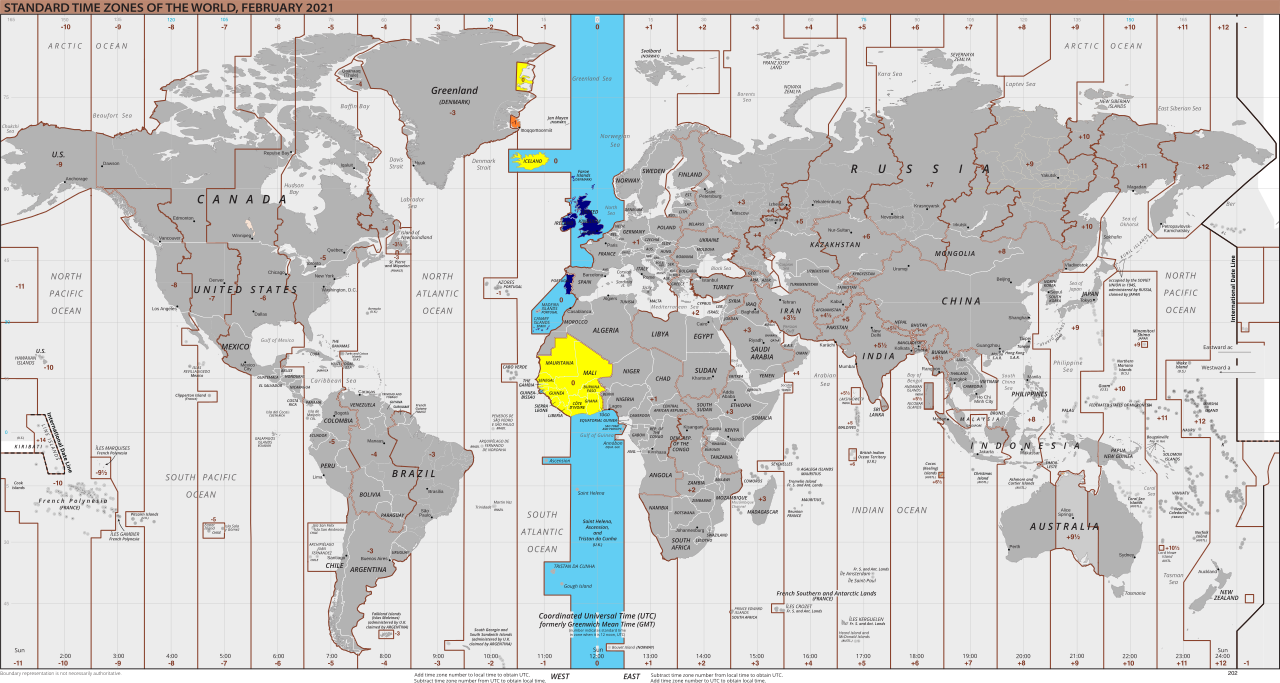
I texted my publisher, Boyd Tuttle, “…[The BIPM conference] was fascinating with some of the best timing experts in the world. Patricia was the moderator. She did a great job. It was all about precise timing science on the Earth and on the moon. In a major way, my book is about science and religion on the most important topic in the Universe.” He responded, “Liked.” He is today selling my books at the Book of Mormon Evidence Conference in Layton, Utah.

The Bureau International des Poids et Mesures (BIPM) of weights and measures was organized in 1875 with 17 signing nations; now there are 103. The BIPM General Conference of Weights and Measures (CGPM) meets periodically. Time went from astronomical time to atomic time in 1967 when the “second” was defined as, “the SI unit of time, equal to the duration of 9 192 631 770 periods of radiation corresponding to the unperturbed ground-state hyperfine transition frequency of the caesium-133 atom.”
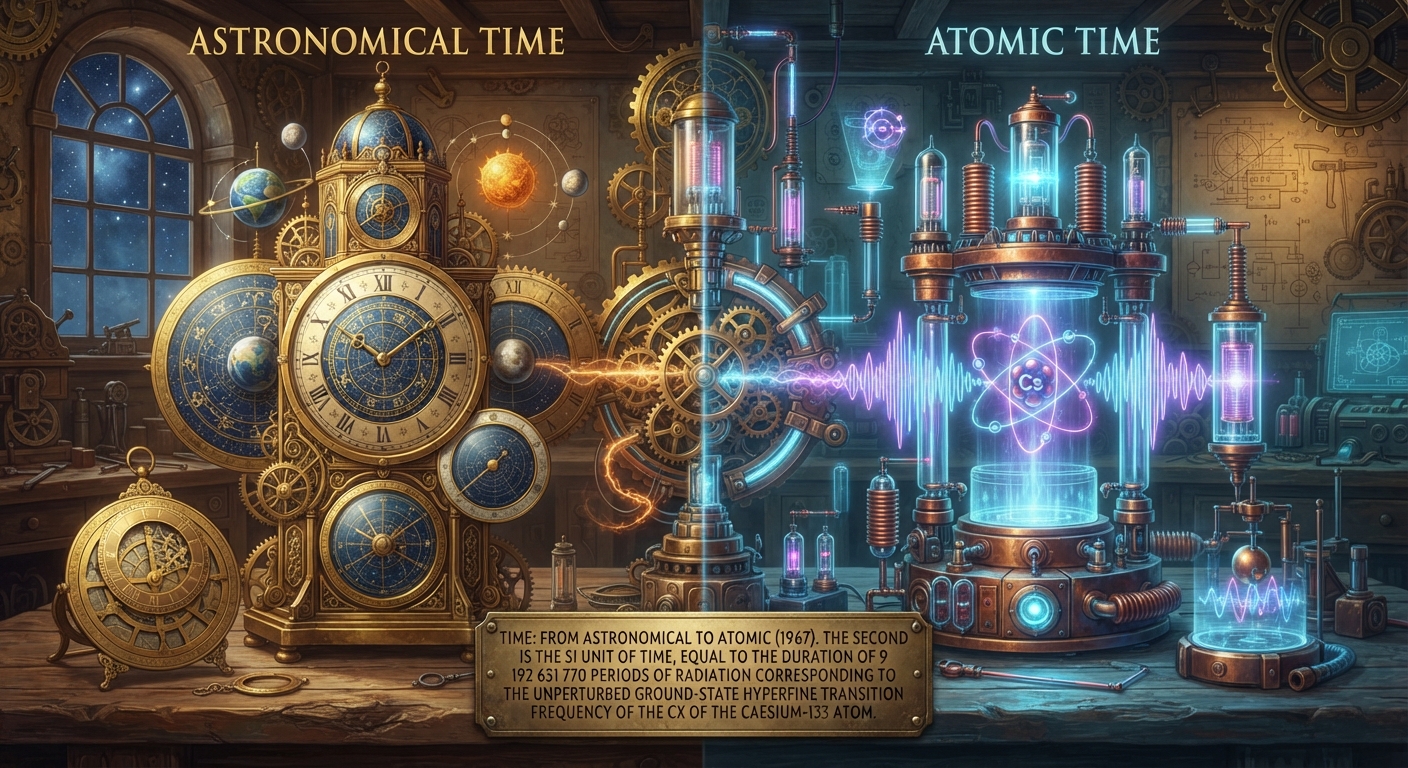
This Thursday (15 October 2026) they shared three draft resolutions. Patrizia informed me that all were approved which included a new definition of the “second” and getting rid of “Leap seconds,” which is really great news. I had recommended that in my first book, It’s About Time, which we published in 2014.
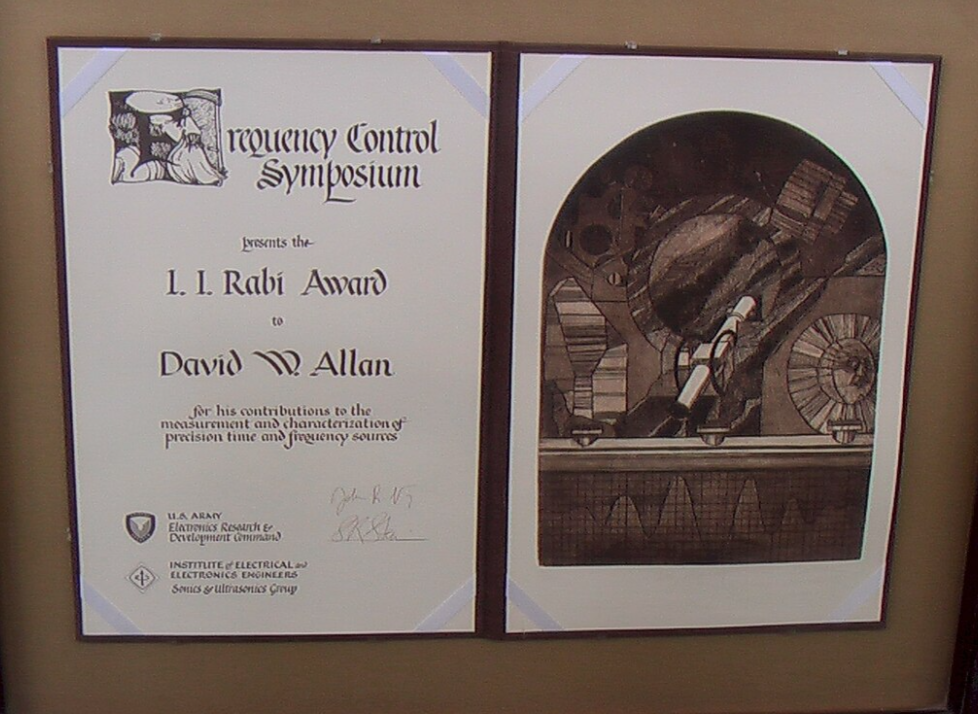
Timing accuracy has improved a billion fold since time was kept astronomically. It has been so exciting to be part of these enormous advancements and to witness many of the benefits thereof; GPS is an example. Isidor Isaac Rabi invented atomic clocks. An award was named after him, and he was the first recipient of the RABI AWARD in 1983. I was the second recipient because the Allan variance, σy2(τ), showed how to use atomic clocks and how to predict time with them.
Now for the Technical Part
The most accurate astronomical measurements are about 1 x 10^-9. At the CGPM, D. Calonico from Italy shared that the most accurate atomic clocks are at the 2 x 10^-18. After the conference, I shared with Patrizia the recent better results this year from NIST/JILA of 5.5 x 10^-19. This is like measuring the distance to the sun (93 million miles) to about one thousandth of the thickness of a human hair. I pulled out one of mine to measure it, and I don’t have many to spare! The NIST/JILA amazing stability reported was σy(τ) = 3.5 x 10^-16 1/square-root of (τ/s). The “y” denotes the fractional frequency, (ν(t) – νo)/νo, where ν(t) is the actual frequency at time t and νo is the nominal frequency.
One can see why a new definition is needed from the following equation: after a measurement (averaging) time τ.
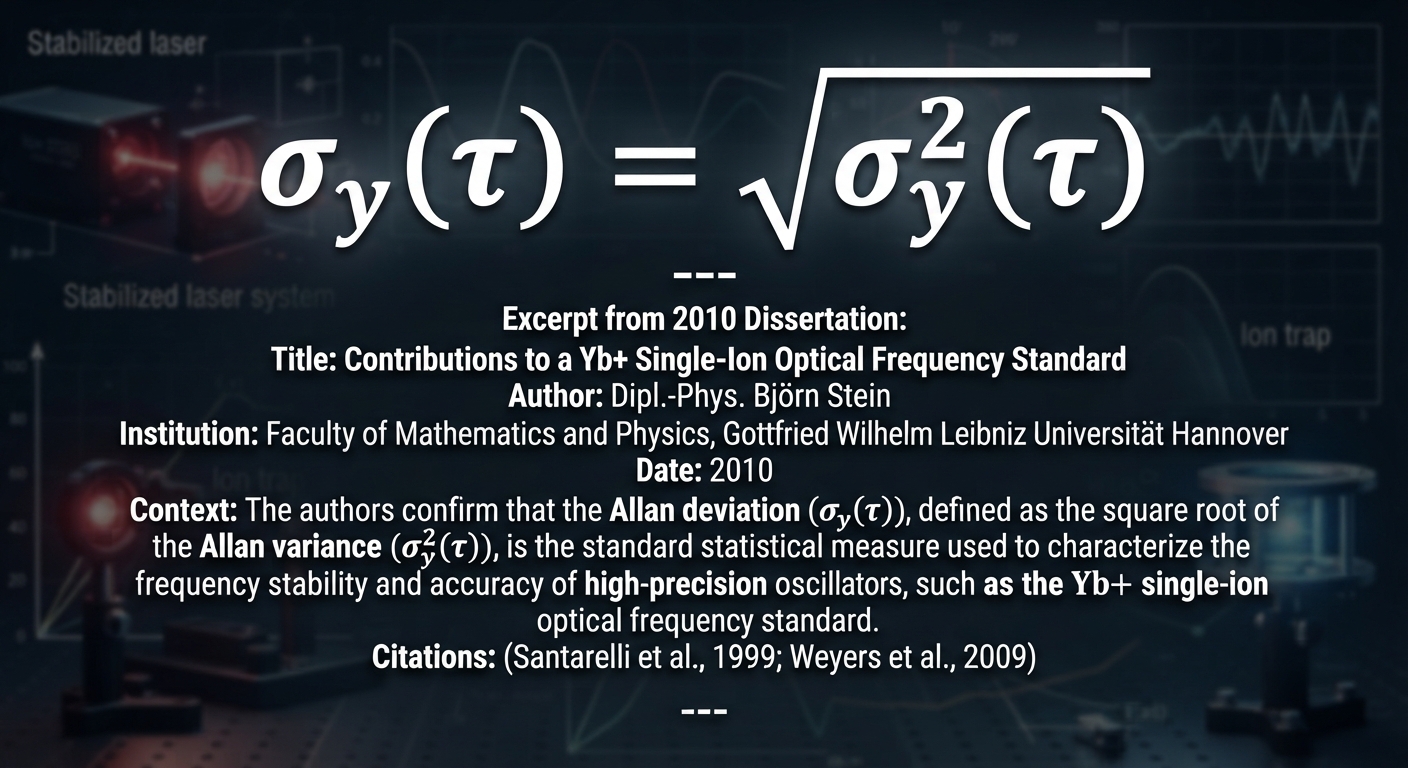
The equation: σy(τ) = 1/π 1/Q 1/S/N 1/square-root(τ/s).
This equation expresses instability using the Allan deviation. The reference transition’s quality factor, Q = ν/∆ν, represents the ratio of transition frequency (ν) to effective line width (∆ν), which, at best, reaches the Fourier limit for the interrogation cycle period (T). Finally, the achievable frequency depends on the signal-to-noise ratio S/N. Assuming no squeezing, quantum projection noise (Itano et al., 1993) leads to a signal-to-noise ratio that scales with the inverse square root of the number of atoms probed.
Since the Q of optical clocks is about 100,000 higher than microwave clocks like the cesium atomic clock defining the second since 1967, the optical clocks have a great advantage and the new definitions approved from this CGPM reflected that advantage. Since there are several competing optical atomic clock transitions, it becomes quite complicated. The conference dealt with those complications.
Knowing Earth time, UT 1, is very important as well, and Professor D. Agnew from the University of California–expert on earth rotation—addressed that at the conference. I shared with Patrizia that he might be interested in a paper that Jim Barnes and I wrote in 1967. It shows that the random walk model that he shares is not as good a model as is flicker-noise FM out to one cycle per year and then the time dispersion goes as τ-5 (flicker run). I also suggested to Patrizia that he might find useful a paper we wrote about long-term resonances that we have found in 200 years of Tropical year data, she said she would.
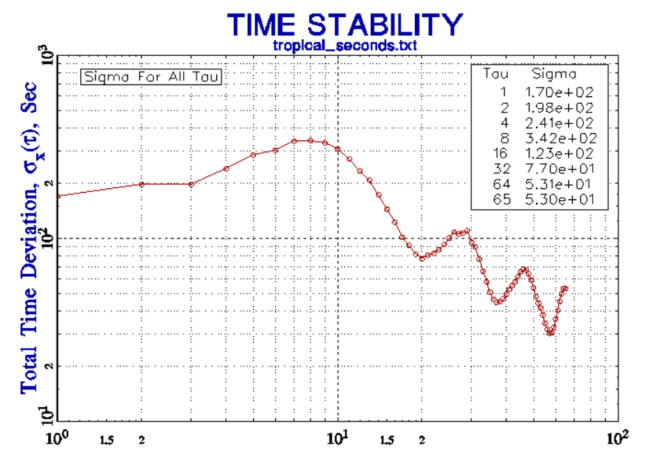
The above stability plot is the square-root of TVAR = tau^2 MVAR/3, and x is the integral of y, where x is the time variations and y is the fractional frequency variations.
Summary
This has been an incredible week, but most important for me is that my new book is now available from my publisher and from Amazon to help the scientific community as well as for the world to appreciate what is really important: THE INFINITE ATONEMENT OF JESUS THE CHRIST, AND IT’S SIGNIFICANCE IN THE LAST DAYS.
The conference was totally secular; the brilliant minds of the world need to solve the world’s problems. This ignores that the most serious problem in the world is people turning from God and the moral decay that is happening all over the world as a result. The answer is turning to Christ and totally repenting of all our sins. He is the way and the truth and the life (John 14:6). Look to God and live the abundant life He promises the faithful (John 10:10; Alma 37:47).
His invitation is to come to know Him and receive the Eternal Life promised; it is the greatest of all the gifts of God (John 17:3; D&C 14:7) “¶ For God so loved the world, that he gave his only begotten Son, that whosoever believeth in him should not perish, but have everlasting life (John 3:16).”
Now you have to wait for 429,228,004,229,872.992 cycles of the Strontium-87 optical transition to accumulate one second! I thank you, Lord, for giving us AVAR, MVAR, and TVAR to help humanity better benefit and enjoy the blessings from their use in the communities of time and frequency, navigation, and telecom. And we have seen their utilization in many other fields.