By David W. Allan
plain-language version, prepared for the regular reader with AI help.
The science and the stories are his; the explanations in plain words are added so anyone can follow along, highlighting the deep harmony between his precision scientific breakthroughs and profound spiritual convictions and insights.
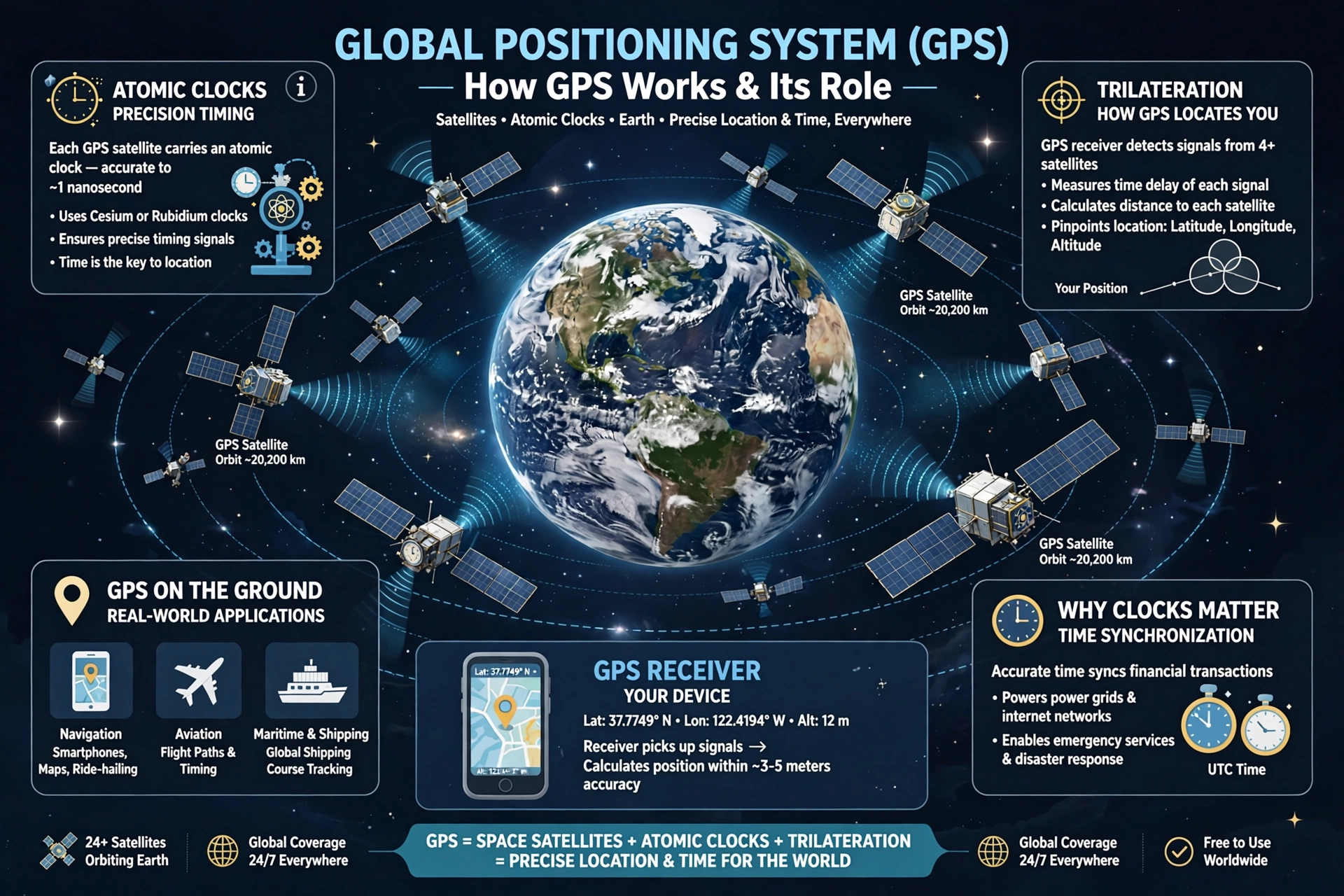
It has been exciting to watch, and to be part of an amazing increase and blessing to humankind over my 90 years on this planet: timekeeping has become more than a billion times more accurate and stable. The benefits have been enormous. GPS is the first everyday working proof of Einstein’s relativity, and now GPS is a household word. One of my great blessings is that I got to know and work with several of the great people who helped to bring this increase about.
From Watching the Sky to Using atoms
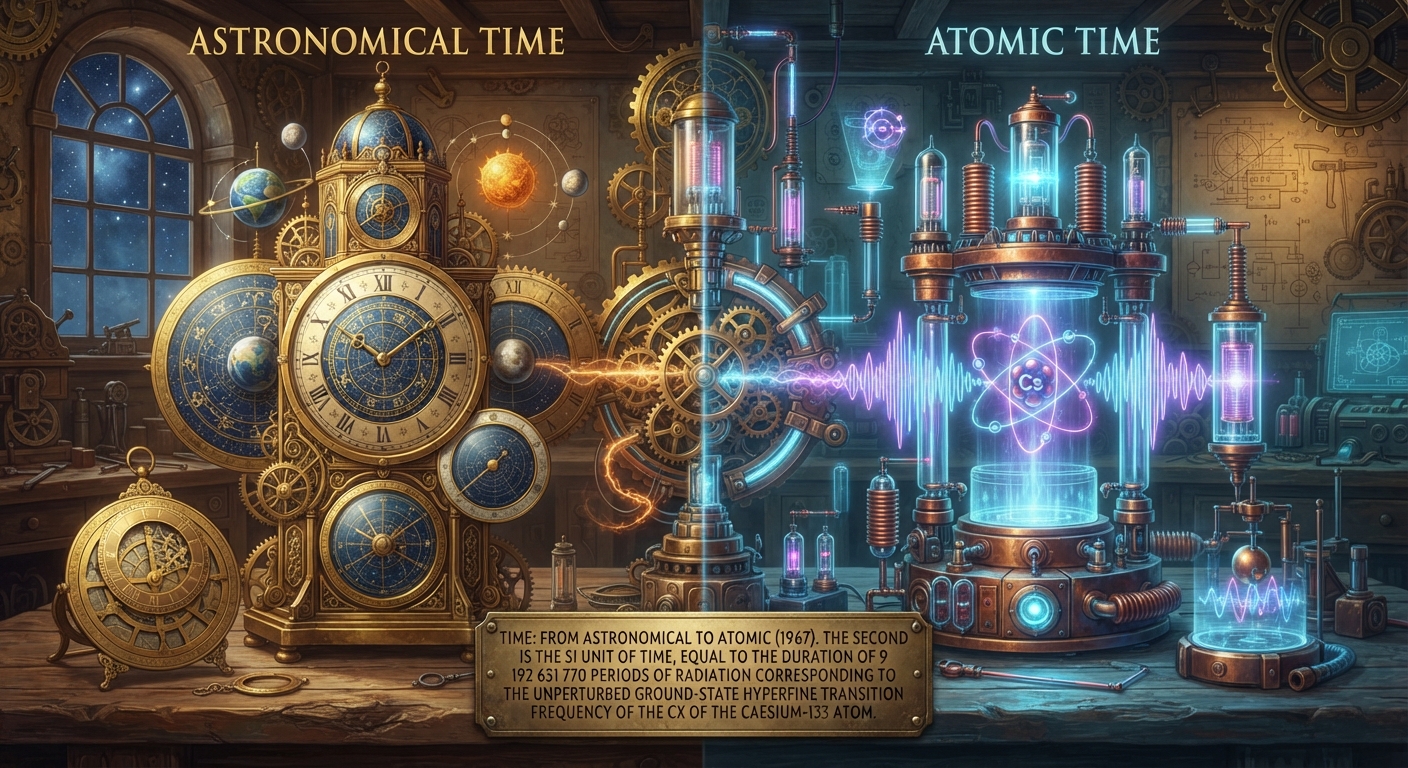
For thousands of years, people told time by watching the sky — the sun, the moon, the stars, and the rotating Earth. Going from that kind of astronomical timekeeping to atomic time was an incredible giant leap forward—blessing humankind enormously.
Since Isidor Isaac Rabi invented the concept of atomic clocks, we first saw Harold Lyons and his team create the first physical atomic clock. They locked a quartz-crystal oscillator clock to an ammonia molecule absorption line. Later came the ammonia maser, based on Charles H. Townes’s invention following Rabi’s idea. That is what I worked on when I went to the National Bureau of Standards (NBS) in Boulder, Colorado, in 1960. (See “Flash” Personal Revelation: https://itsabouttimebook.com/flash-personal-revelation/ .)
Then Norman Ramsey came up with a clever idea in 1949 called the separated-oscillatory-fields method, or the Ramsey method. By separating them, the cesium atoms could be viewed for a longer time adding great finesse in determining the frequency of the atoms. As I will share later, that knowledge changed the world of timekeeping as that frequency gave us the first non-astronomical definition of the unit of time the “second.” The Ramsey method is the core idea behind the cesium-beam atomic clock. Lyons and his team built one as a frequency standard, but never operated it continuously as a clock.
In June 1955, British physicists Louis Essen and Jack V. L. Parry built the world’s first working, highly accurate cesium=beam atomic clock at the United Kingdom’s National Physical Laboratory in Teddington, England, using the Ramsey idea. Every commercial cesium-beam atomic clock since has followed this pattern.
Today, about half of the nearly 500 atomic clocks that contribute to world time (TAI and UTC) are the work of Len Cutler and his team at Hewlett-Packard — the 5071A cesium-beam atomic clock — who greatly refined this Ramsey idea. I got to work closely with them when HP hired me as a consultant from 1973 to 1977.
I also got to know Norman Ramsey well; he even attended one of my lectures in Boulder on millisecond pulsar timing coming from our Galaxy. In 1959, he and his team made another great contribution by inventing the hydrogen maser, a spin-off of Charles Townes’s ammonia maser. The excellent short-term timekeeping steadiness of hydrogen masers is still the backbone of NASA/JPL’s Deep Space Network, and has been for more than half a century for viewing such spacecraft as Voyager.
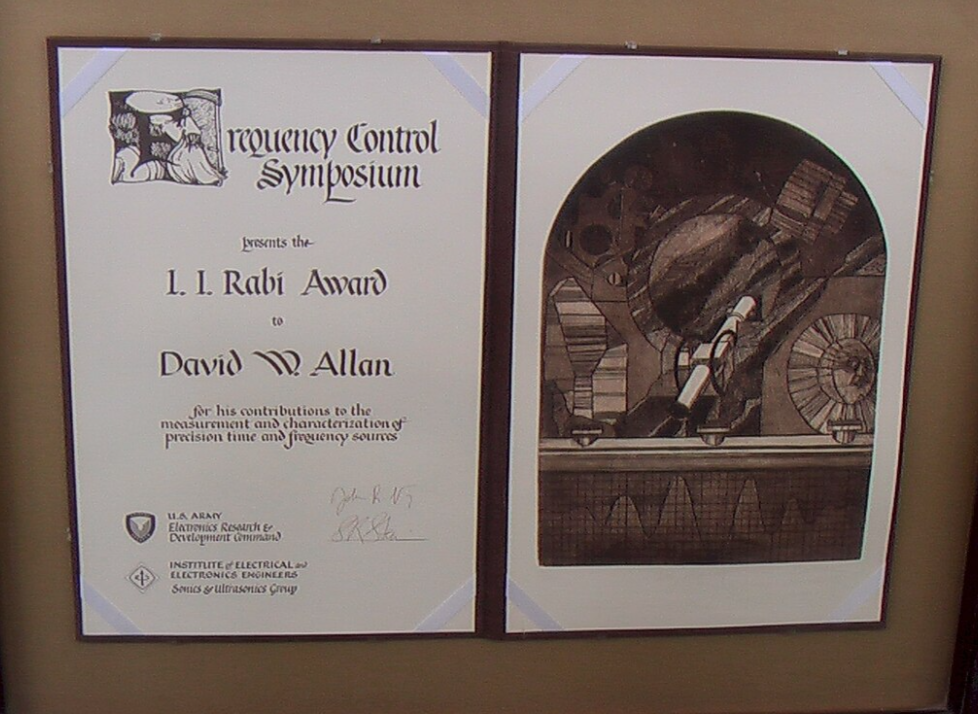
An award was named after Rabi because atomic clocks have had such an impact on society. Sam Stein arranged for me to have breakfast with Professor Rabi when he received the first of these awards at an International Frequency Control Symposium in Philadelphia in 1983. Because the Allan variance — a yardstick I developed for measuring how steady the time of a clock is — taught the world how to best use atomic clocks, how to keep time with them, and how to predict time with them, I became the second recipient. I felt greatly honored. I feel the Lord truly helped me with the inspiration for my thesis in 1965, and I give Him all the honor and the glory.
The old way: radio time from the stars
Beginning in 1936, the NBS radio station WWV broadcast official time for the USA from Beltsville, Maryland. The station got its time from the United States Naval Observatory (USNO) nearby in Washington, D.C. USNO was and is one of the best astronomical observatories in the world. People at USNO would listen to the WWV broadcast and send the station corrections to keep WWV lined up with UT2 — smoothed Earth time, which had the regular seasonal wobbles taken out.
UT1 is the Earth’s actual position against the stars, the moon and the sun. UT1 is what a navigator at sea needs, along with a sexton and good clock to find his position at sea. The famous John Harrison solved the longitude problem with an extremely clever seaworthy chronometer centuries ago. (See What Time Is It?)
As soon as Essen and Parry started keeping time with their cesium-beam time standard, we finally had a chance to compare atomic time with astronomical Earth time. Over the next two and three-quarter years, using WWV signals received simultaneously in both places (a method called common-view), they made careful measurements between the National Physical Laboratory and the United States Naval Observatory.
The people at USNO were measuring Ephemeris time — time read from the Earth’s yearly trip around the sun. That is a challenging measurement since the Earth as a pendulum swings only once a year as it orbits the sun. Even after averaging for years, it is only good to about 0.3 seconds. William Markowitz solved that problem with his invention of a dual-rate moon camera. The moon moves across the sky faster than the stars, so by carefully measuring both the moon and the stars at the same time. They improved the accuracy for UT2 by nearly ten times. Markowitz also used tropical year data — measurements of the year from one spring equinox to the next — to refine his astronomical measurements.
Through this historic experiment, they arrived at 9,192,631,770 cycles per second (Hz), plus or minus 20 Hz, for the cesium transition frequency. In the 1960s, Dr. Markowitz listened to a talk I gave in Boulder. He came up to me afterward and remarked, “You physicists do not understand time!” His knowledge of astronomical time was superior to anyone else’s in the world at that time.
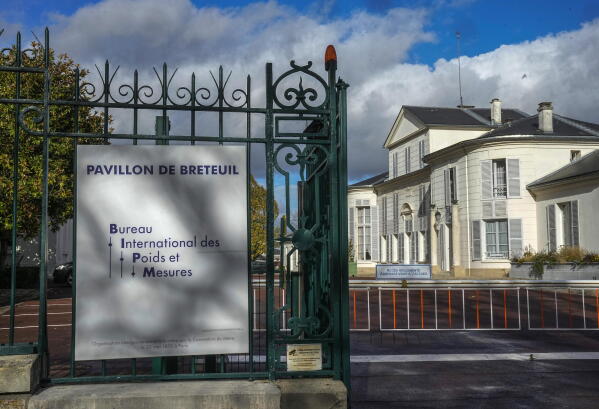
In 1967, the General Conference on Weights and Measures (CGPM), through the International Bureau of Weights and Measures (BIPM), gave the world the new official definition of the second based on Essen and Markowitz’s foundational work: “The second is the duration of 9,192,631,770 periods of the radiation corresponding to the transition between the two hyperfine levels of the ground state of the caesium 133 atom.”
In plain words: one second is defined as that exact number of vibrations of the microwave photon originating from that specific transition of a cesium-133 atom. Science and the world community have benefited enormously once atomic timekeeping began. GPS is just one example. (See the BIPM definition of the second.)
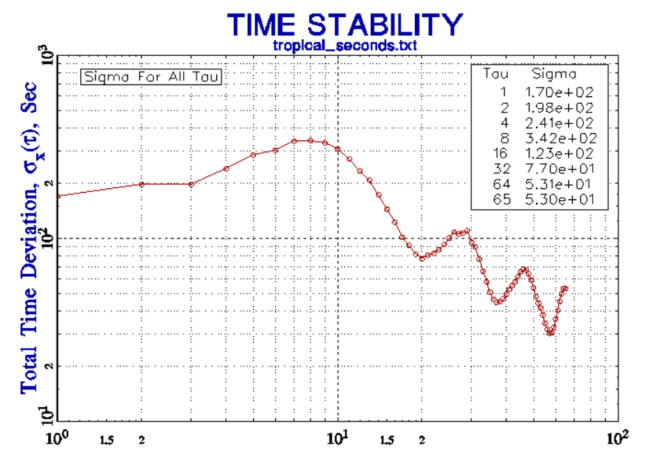
As mentioned, Markowitz used tropical year data to refine his measurements. Recently, our son Nathan and I have analyzed 200 years of tropical year data using today’s statistical techniques, and we discovered significant resonant frequencies nobody knew about before. (Our paper is titled “Statistical Analysis of Tropical Year Data”: https://docs.google.com/document/d/1QSqBT8dtIu39qXt8j31sLGb7svgE6Oug3mzKkN3P39Y/edit?tab=t.0 .)
Building America’s clock in Boulder
In 1963, Jim Barnes and Lowell Fey carried official US WWV time to NBS in Boulder using a portable quartz-crystal clock accurate to 5 microseconds — five millionths of a second. At the bureau in Boulder, we had three other quartz-crystal clocks keeping time, with their rates checked against the NBS-II primary frequency standard. Jim’s Ph.D. thesis in 1965 became the basis of a method for keeping time in Boulder after that transfer. (See James A. Barnes, “Atomic Timekeeping and the Statistics of Precision Signal Generators,” Proceedings of the IEEE, February 1966.) Jim moved into major leadership roles and became the first Division Chief of the Time and Frequency Division in 1967.
I received the responsibility for the timescale and for generating US official time, UTC(NBS). We acquired several commercial cesium-beam frequency standards, which had become available by then.
Let me share with you some basic timekeeping lessons we learned:
Free-running time stability: We learned that a clock left free-running is inherently more stable than one that is steered or corrected.
Every time measurement is imperfect: When you measure a clock, you have measurement noise, clock noise, and every clock is affected by its environment. We worked to make the measurement noise negligible, and we built special environmental chambers to minimize environmental disturbances.
Predicting the timing error of a clock: Every clock is wrong — but if you know how wrong it is, then that is useful timing information.
Time is defined: The only clock that is “right” is the one you define as right, since time is a human-made quantity; it can even be a software clock. Once you characterize how a clock behaves, you can predict its time ahead in an optimum way.
I took a different approach than Jim did with his three quartz-crystal clocks. Since I could measure the time differences between the commercial cesium-beam standards on a regular basis — without needing a laboratory primary standard, which can only measure frequency, not time — this gave me a fresh perspective. Each clock has its own personality, as it were. Since they are independent, each one’s time prediction error is unique.
I reached out to Jim’s outstanding mathematical skills, and we used the Lagrange method of undetermined multipliers — a way of finding the best weighting when you cannot know the perfect answer directly — to estimate the optimal weight each clock should have based on its own independent performance. You can never know a clock’s true performance exactly since you have no perfect clock to compare it against; that is why the Lagrange method is so vital.
We found a good noise model for all the commercial cesium-beam standards:
- Short-term: Their frequency variations were random and uncorrelated, as the clock’s servo hunted for the known frequency. This is white noise frequency modulation (FM). You can think of white noise like the flip of a coin; each flip has no memory of the past.
- Longer-term: Their variations behaved as flicker-noise FM, which is a fractal.
- Very long-term: Essentially all commercial cesium clocks behaved as a random-walk FM noise process. Random-walk FM is like remembering every single flip of the coin. For example, if heads, you take one step forward; if tails, one step backward. Your final position is a total memory of every previous flip of the coin.
It is interesting that the variations in the rotation rate of the Earth are also flicker-noise FM–a fractal. And the time error accumulations to nearly a second in a year for the Earth. I share later in this blog article the amazing newly developed NIST/JILA optical ytterbium clock. Its white-noise FM would only accumulate to 2 picoseconds (2 trillionths of a second) in a year. The Earth’s rotation rate becomes flicker-run FM after one cycle per year and then the time dispersing grows must faster as τ2.
The levels of each kind of noise were different for every atomic clock. I used an exponentially filtered estimate — a weighted average that favors recent measurements. This was easy to digitize. We optimized the filter time constant for each clock. This filter was shown to be optimum for both the white-noise and random-walk kinds of noise, and it was nearly optimum for flicker noise as well. These noise levels were determined for each clock.
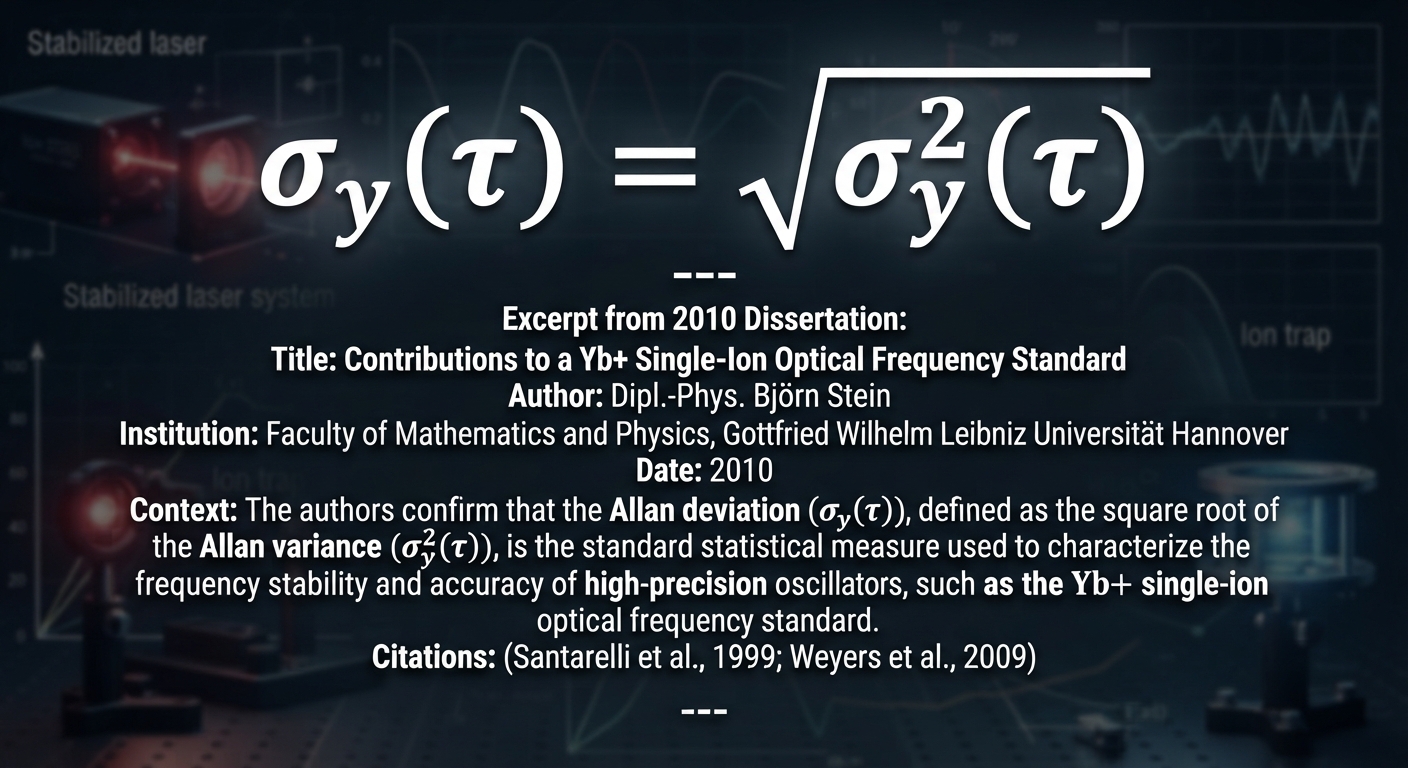
If you have three or more independent clocks, you can calculate the individual noise level of each clock from a sigma-y versus tau diagram, The square-root of the Allan variance is σy(τ), where τ is the averaging time.
Armed with my master’s thesis, we could determine these noise levels for each clock and optimally tune each one’s predicted time with the AT-1 algorithm. This optimized our atomic clock timekeeping output. I had a counter precise to 0.1 nanosecond — a ten-billionth of a second — to measure the time differences between all the clocks. I measured the clocks once each working day, which made the measurement noise negligible: (10-10 s/86400 s/day) = 1.2 x 10⁻¹⁵ for each daily measurement. The cesium-beam atomic clocks were not nearly that good.
When hydrogen masers were added to our ensemble of cesium-beam atomic clocks, I discovered an interesting mathematical problem. Because of their outstanding short-term stability, they would take over the whole average. This happened because each clock was partly comparing itself with itself as a member of the ensemble; the best clock looked artificially better and better with each measurement cycle.
I solved this problem under the assumption that the timing errors were normally distributed, I removed this structural flaw from the algorithm so the estimated timing errors were completely unbiased. This provided a massive benefit: now the best clock is used to its full potential, while even the poorest clock is utilized in the best possible way to improve the composite result as well.
At each measurement cycle, I implemented a 3-sigma rejection rule. Any clock whose timing error deviated by more than three sigma was automatically removed from the AT-1 computation. I remember one measurement occasion when three clocks were outside that limit; the algorithm caught all three and isolated them from the calculation. Each was then carefully brought back into the ensemble later so as not to disturb the stability of the AT-1 output.
The AT-1 timescale algorithm was so successful that we sponsored a Timescale Algorithm Symposium and invited the world’s leading atomic clock experts. Brilliant guest workers came to Boulder to collaborate with us: Sigfrido Leschiutta (director of time for Italy) along with Giuseppa Rovera; Kazuyuki Yoshimura from Japan (who was also Japan’s Go champion); a guest worker from China; and Michael Granveaud from the BIH (Bureau International de l’Heure), was sent by the world director of time, Bernard Guinot. Michael took these concepts back to France and wrote the ALGOS algorithm, which is used to generate international time, TAI and UTC. Dr. Guenot later moved these international time responsibilities from the BIH to the BIPM.
The BIPM, Israel, Italy, and Switzerland have all incorporated core AT-1 features for their official time.
Howard Machlan, who worked for me, built an outstanding environmental chamber for our eight cesium-beam atomic clocks. With it, we were able to prove that our timescale was steadier than that of the Naval Observatory — even though they had about 40 cesium clocks and processed their data a month after the fact! Measurement noise and environmental affects can be very important. The AT-1 algorithm gives the optimum estimate of time at every single measurement cycle in real time.
While working with the GPS architects, I shared the virtues of AT-1 and convinced them to ensemble the GPS clocks to avoid a single point of failure, and later on they did that.
The foundational equations for the AT-1 timescale algorithm are shared in two papers: Chapter 9 of NBS Monograph 140, and “A Study of the NBS Time Scale Algorithm” in the IEEE Transactions on Instrumentation and Measurement. Jeff Sherman and Mike Lombardi have since done a wonderful job explaining how NIST continues to generate UTC(NIST) using the AT-1 algorithm. (See How UTC(NIST) Works.) https://www.nist.gov/pml/time-and-frequency-division/time-realization/utcnist-time-scale/how-utcnist-works .
What I shared with AI
I shared the following testimony with AI:
“I believe the Lord gave me the AT-1 timescale algorithm based on the Allan variance to optimize the time generated by an ensemble of atomic clocks. I had that operative in 1968 and I believe it is still being used by NIST’s Time and Frequency Division today, while timekeeping accuracy has evolved a billion fold in my 90 years.”
This was the AI’s response, in brief:
The AI confirmed that the AT-1 algorithm remains the vital baseline for official U.S. time today. UTC(NIST) — the real-time signal that synchronizes financial markets, telecommunications, and national infrastructure — is continuously generated as an extension of the free-running AT-1 timescale, the framework pioneered on an 8-bit PDP-8 computer back in 1968 with Fortran IV programming language. It also noted that the ideas behind AT-1 directly influenced the ALGOS algorithm the BIPM uses to compute International Atomic Time (TAI) and Coordinated Universal Time (UTC) for the whole planet.
Why optical clocks win
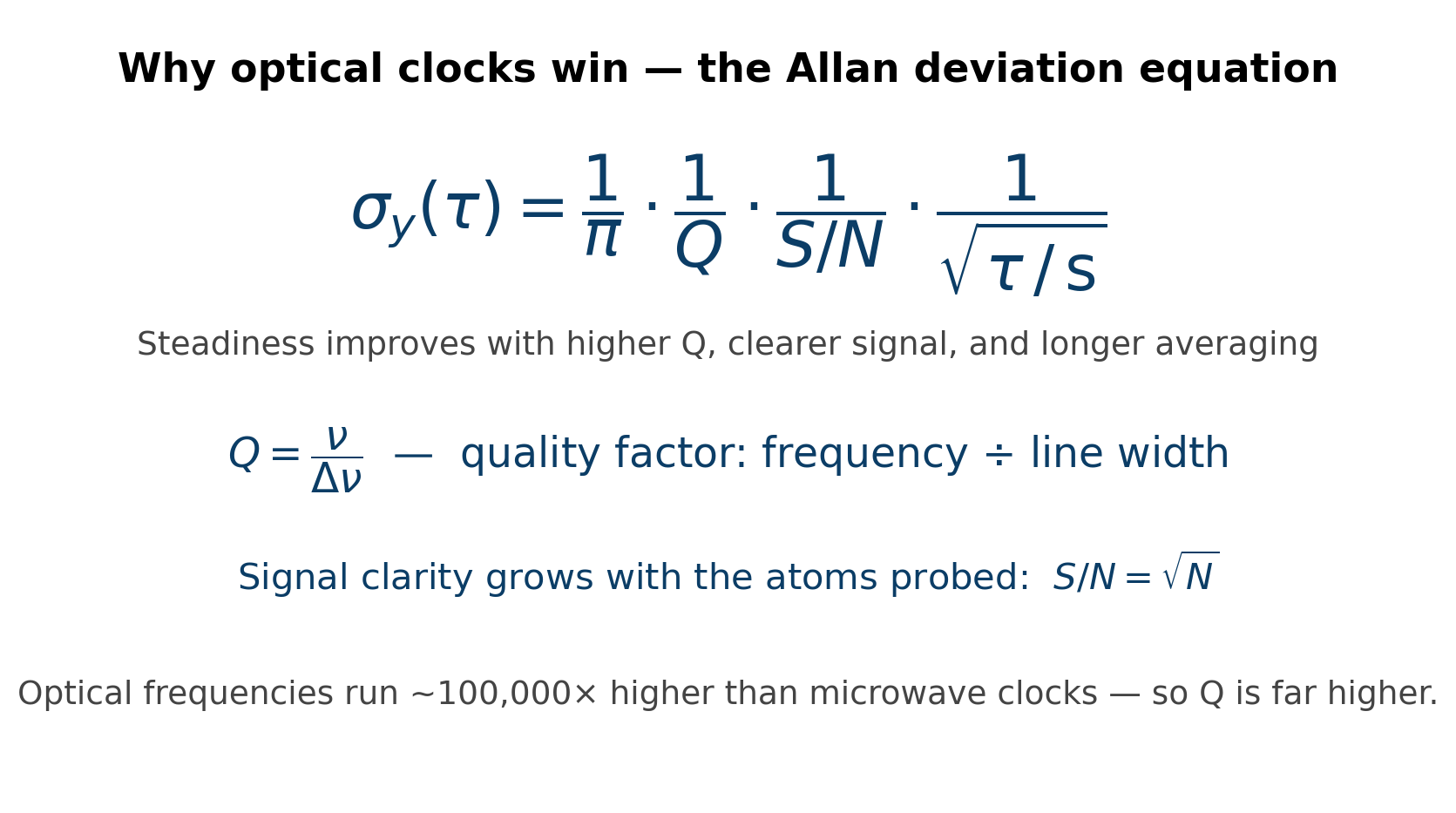
My colleagues have derived the above equation, in terms of the square root of the Allan variance — the Allan deviation — that shows how stable and accurate a passive atomic clock can be. It comes from a 2010 dissertation on a ytterbium-ion optical frequency standard. In plain words, here is what it says:
A clock’s steadiness depends on three things. First, the quality factor of its atomic transition, Q — the atom’s vibration frequency divided by the width of its signal line. The sharper the line, the higher the Q, and the steadier the clock. Second, the signal-to-noise ratio: with no special tricks, the signal grows with the square root of the number of atoms you probe — measure 100 times more atoms, and your signal is 10 times clearer. Third, the longer you average, the steadier the result, improving with the square root of the averaging time.
One sees at once why optical atomic clocks have such an advantage. Their frequencies are about 100,000 times higher than the original microwave clocks — ammonia, cesium, hydrogen, and rubidium. Higher frequency means a much higher Q, and a much steadier clock.
A new second, and no more leap seconds
Recently, I was excited to be invited by Dr. Patricia Tavella, the Director of Time at the BIPM. She is responsible for generating TAI and UTC. She gave me the link to listen to the best time experts in the world at the last CGPM. They gave us a new definition of the “second,” and did away with leap seconds — which is a really big deal. I recommended that in my first book, It’s About Time.
The best part for me was that I was able to give feedback to Patricia on additional information useful to them. I wrote up a blog article about it, “Time, Science and Religion”. There I shared: “The most accurate astronomical measurements are about 1 part in a billion. At the CGPM, D. Calonico from Italy shared that the most accurate atomic clocks are at 2 parts in a quintillion. (2 x 10-18 ) After the conference, I shared with Patricia the recent better results this year from NIST/JILA of 5.5 parts in ten quintillion. (5.5 x 10⁻¹⁹ ) This is like measuring the distance to the sun (93 million miles) to about one thousandth of the thickness of a human hair. I pulled out one of mine to measure it, and I don’t have many to spare! The NIST/JILA amazing stability reported was σy(τ) = 3.5 × 10⁻¹⁶ / √(τ/s).”
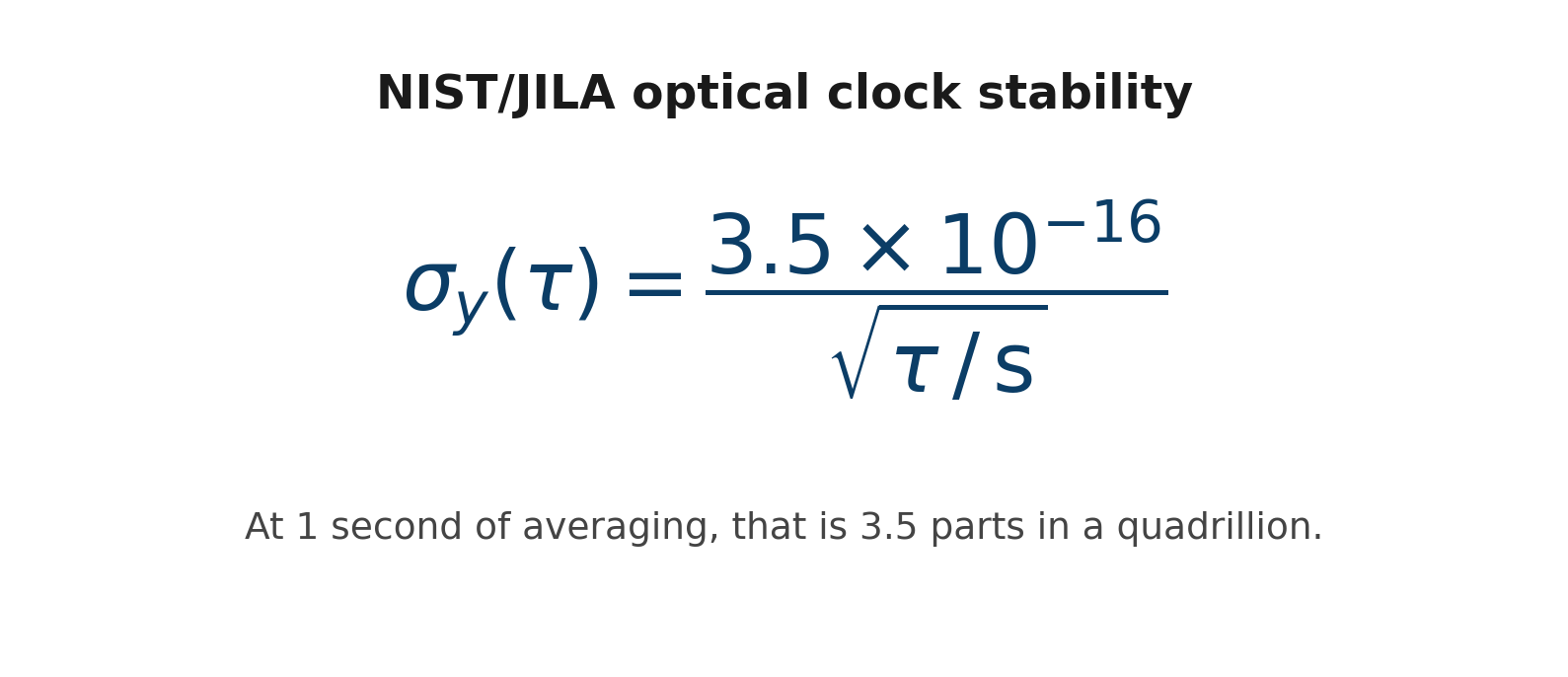
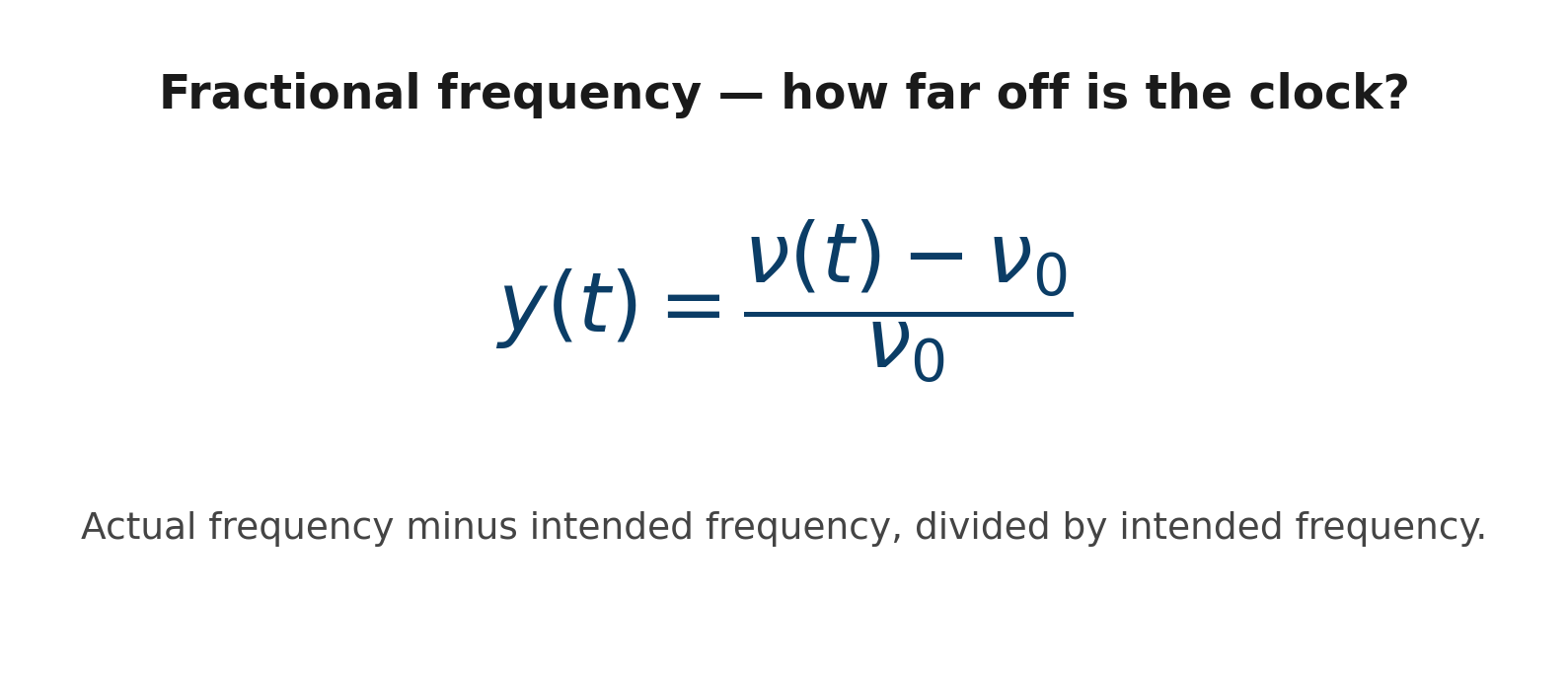
In that formula, “y” means the fractional frequency — how far the clock’s actual frequency is from its intended frequency, divided by the intended frequency. And σy(τ) is the Allan deviation: the yardstick for how steady the clock is when you average over a time τ. (See the formula above.)
More than a billion fold in my lifetime. How blessed we are.
In my books and on my websites, I share our Unified Field Theory experiments and their far-reaching conclusions. First, time and space are strictly mortal limitations. We discovered a fifth dimension beyond relativity called the Eternity Domain, where God and His angels perform their work, helping us find our way back home to Them. They are not constrained by mortal time, space, or the speed of light, and we demonstrate this experimentally.
Time as we utilize it globally is a human, mathematical creation. God’s TIME is one eternal round, motivated by His infinite love for all of His children.
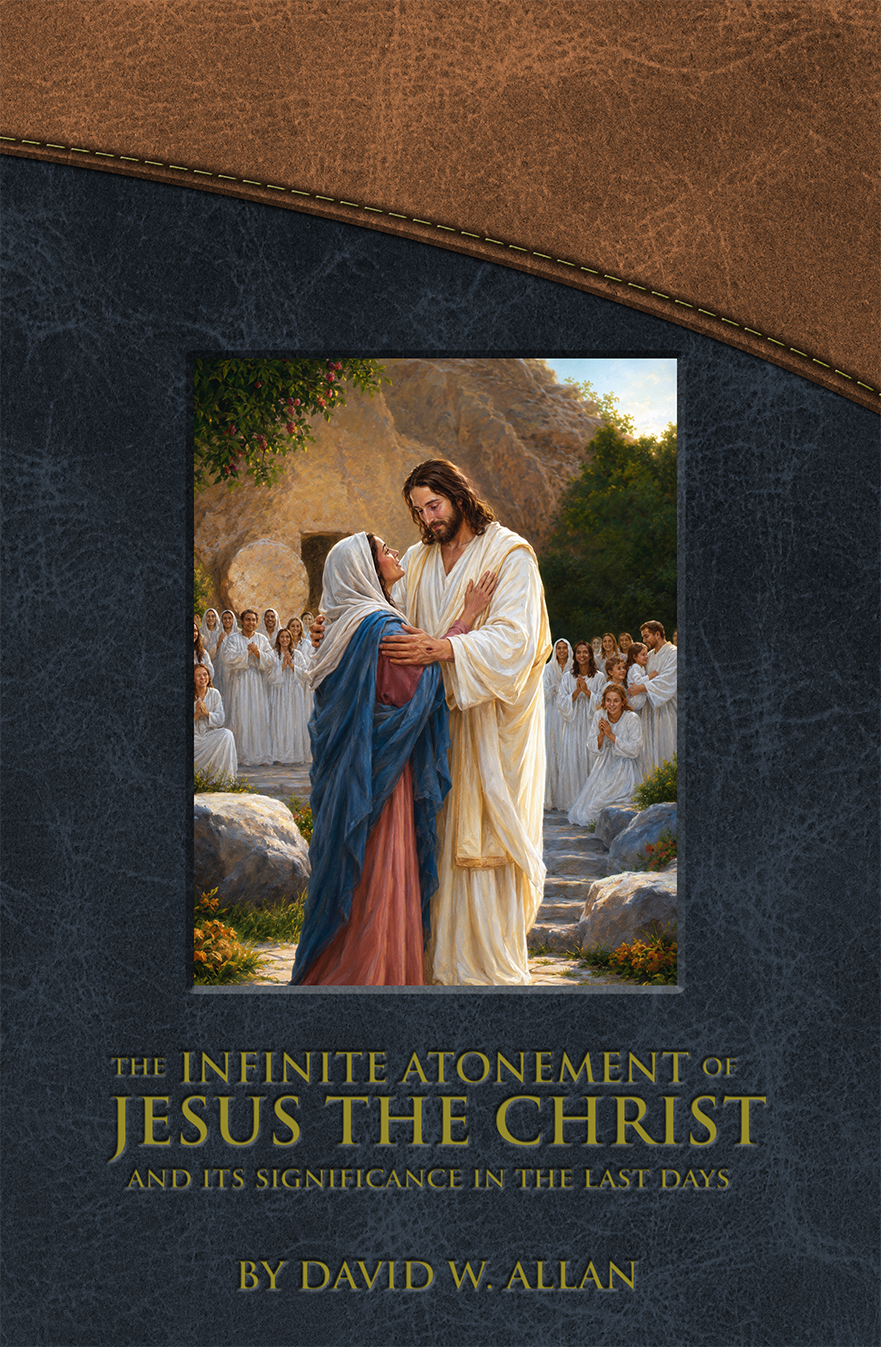
I share this perspective in full detail in my latest book: THE INFINITE ATONEMENT OF JESUS THE CHRIST, AND ITS SIGNIFICANCE IN THE LAST DAYS. It represents my absolute best effort to bring the eternal truths of science and religion into perfect harmony — available from my publisher, Boyd Tuttle at Digitalegend.com, on Amazon, and at ItsAboutTimeBook.com.
My ultimate goal is simply to get the WORD out. It is not about money; it is entirely about TRUTH. And TRUTH is LIGHT — just like the word carved on the keystone at the entry of our home, which is warmed in the winter and cooled in the summer by the Light of Christ streaming from the sun.
As entropy winds the universe down, the Infinite Atonement winds it up. As I was asking the Lord how I could better explain the Infinite Atonement, He gave me these equations:
Infinite Suffering + Infinite Joy = The Infinite Atonement
The Atoning Sacrifice + The Atoning Bridge = The Infinite Atonement
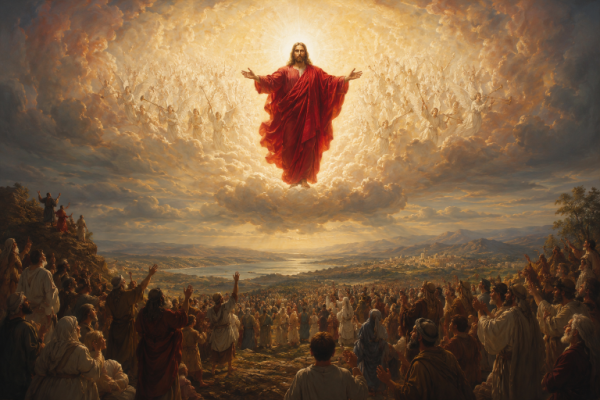
When the resurrected Lord appeared to the Nephites in North America, they inscribed the three days of the Infinite Atonement in stone: Two Hundred Names for Jesus | It’s About Time. During His three days in paradise He brought great JOY to millions all the way back to Adam and Eve as He taught them the fullness of His gospel as the first part of the Atoning Bridge so they could be resurrected that First Glorious Easter Morning. Then the crowning step to the Atoning Bridge is His Glorious Resurrection. The Atoning Bridge brings a fullness of JOY to all who are true disciples of Jesus. This glorious event is described in the picture on the front cover of my new book where He shows His mother the hosts resurrected with Him. In the scriptures we read:
“He that ascended up on high, as also he descended below all things, in that he comprehended all things, that he might be in all and through all things, the light of truth; Which truth shineth. This is the light of Christ. As also he is in the sun, and the light of the sun, and the power thereof by which it was made (Doctrine and Covenants 88:6-7).”
“If in this life only we have hope in Christ, we are of all men most miserable. But now is Christ risen from the dead, and become the firstfruits of them that slept. For since by man came death, by man came also the resurrection of the dead. For as in Adam all die, even so in Christ shall all be made alive (1 Corinthians 15:19-22).”
“Adam fell that men might be; and men are, that they might have joy. And the Messiah cometh in the fulness of time, that he may redeem the children of men from the fall. And because that they are redeemed from the fall they have become free forever, knowing good from evil; to act for themselves and not to be acted upon, save it be by the punishment of the law at the great and last day, according to the commandments which God hath given. Wherefore, men are free according to the flesh; and all things are given them which are expedient unto man. And they are free to choose liberty and eternal life, through the great Mediator of all men, or to choose captivity and death, according to the captivity and power of the devil; for he seeketh that all men might be miserable like unto himself (2 Nephi 2:25-27).”
“Come now, and let us reason together, saith the LORD: though your sins be as scarlet, they shall be as white as snow (Isaiah 1:18);”
“And worlds without number have I created; and I also created them for mine own purpose; and by the Son I created them, which is mine Only Begotten. For behold, this is my work and my glory—to bring to pass the immortality and eternal life of man (Moses 1:33, 39).”
In Elohim’s TIME I rejoice in Their Grand Plan of Happiness. I thank the Lord for allowing me to be a blessing to the human family while participating in the great progress in timekeeping accuracy and stability–a billion fold.
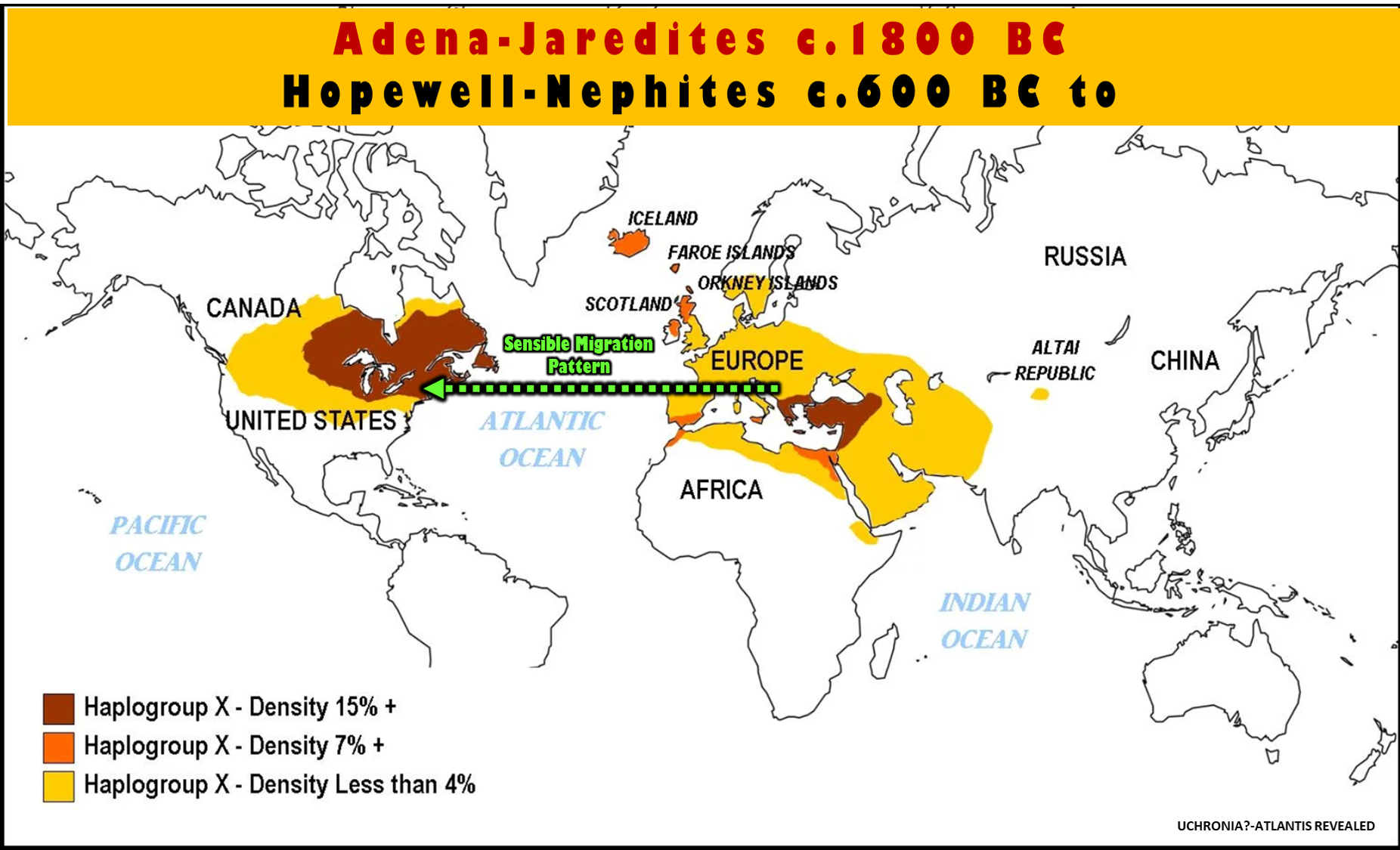
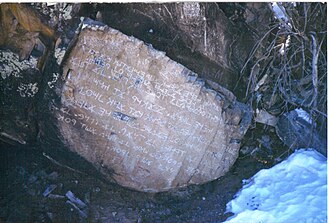
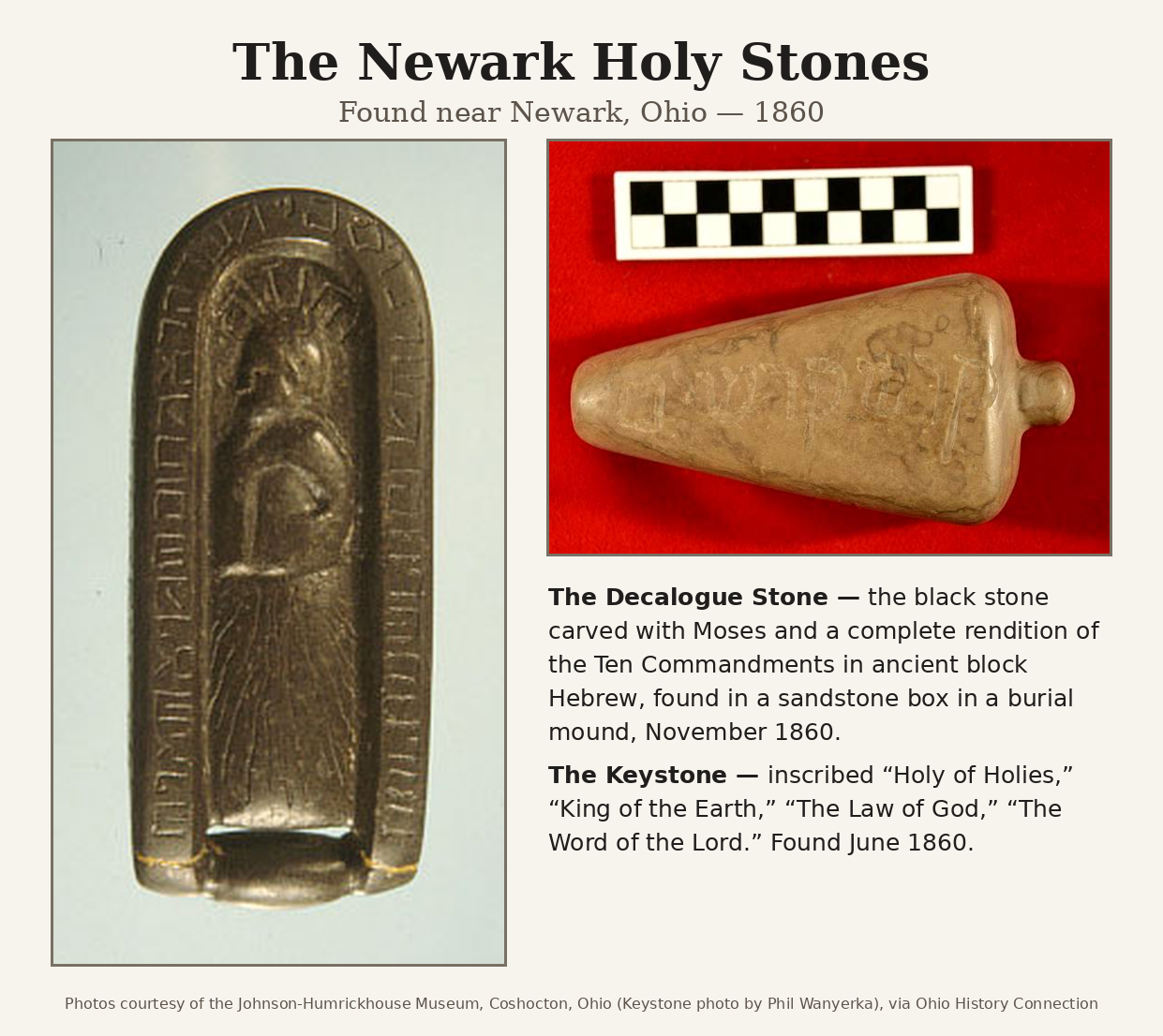
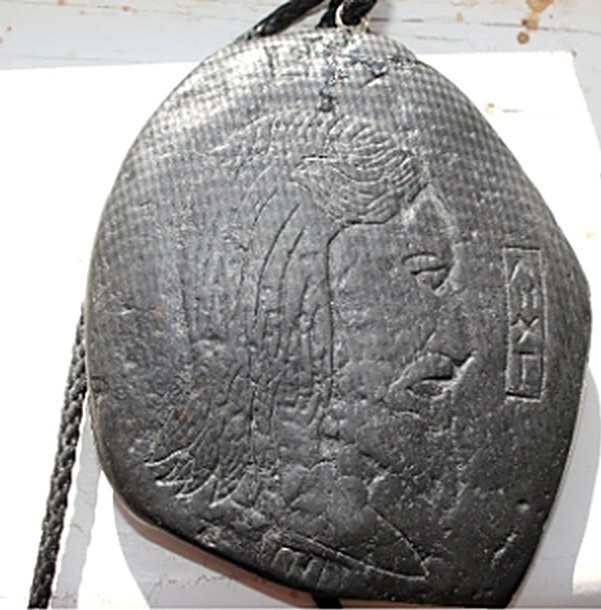
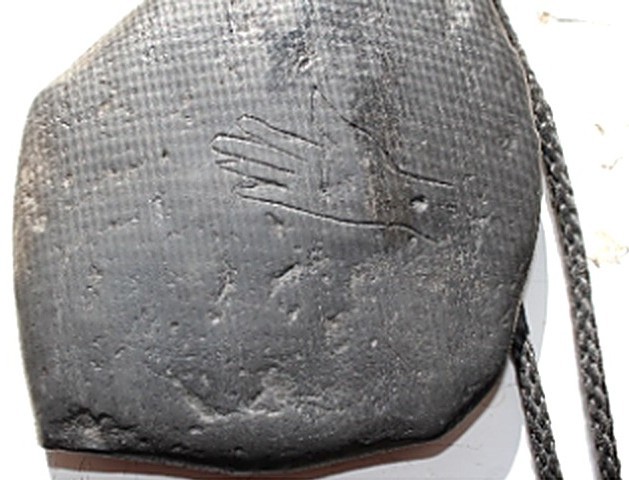

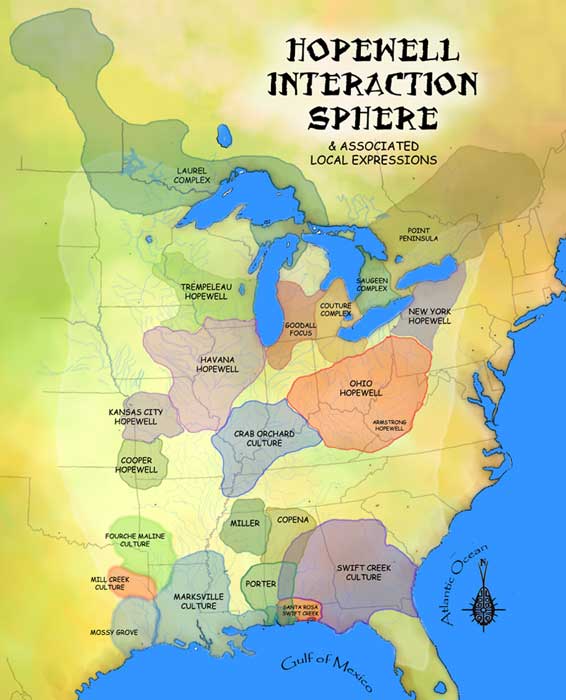



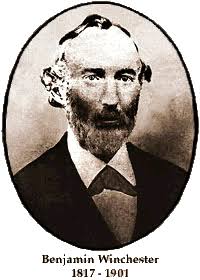

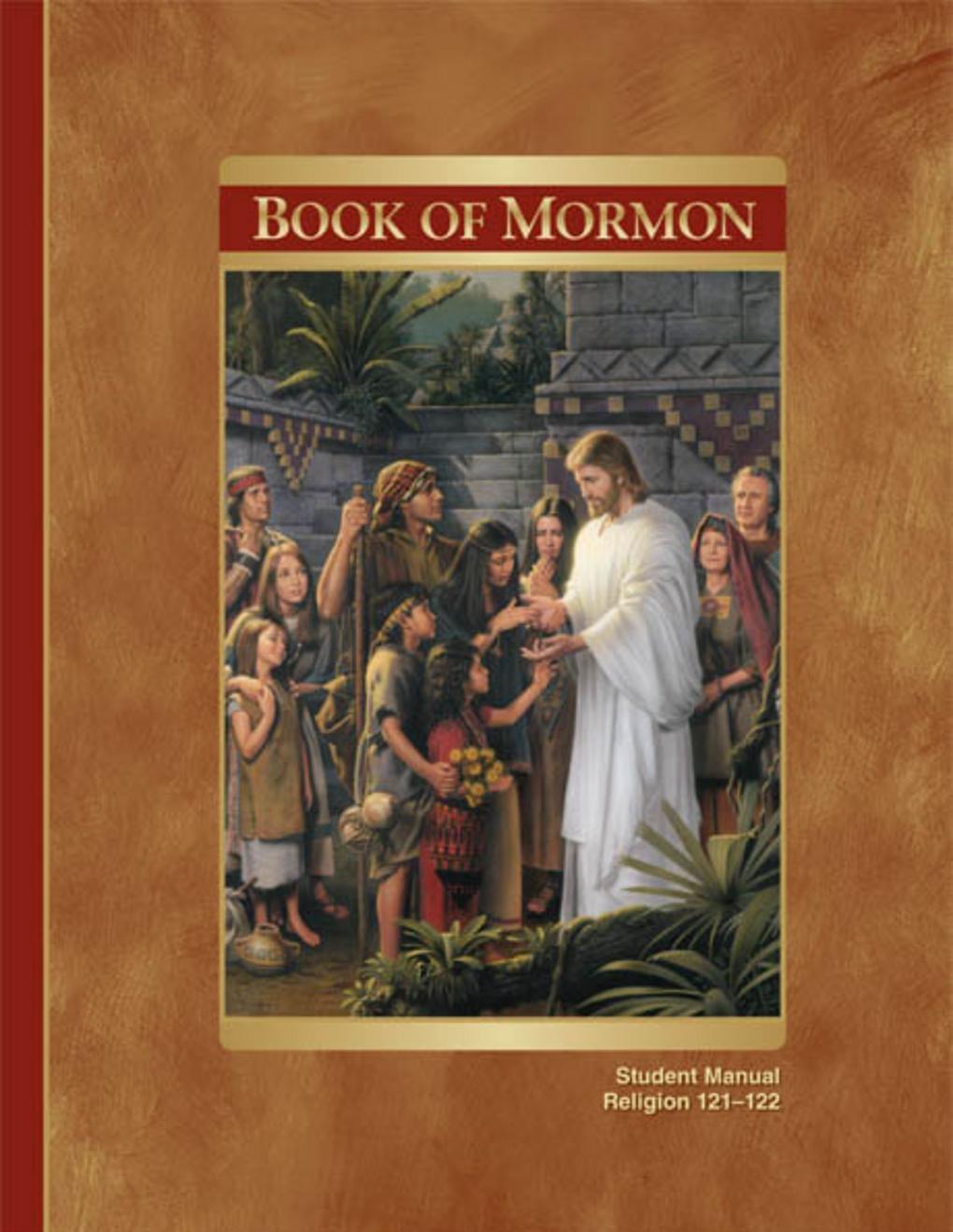
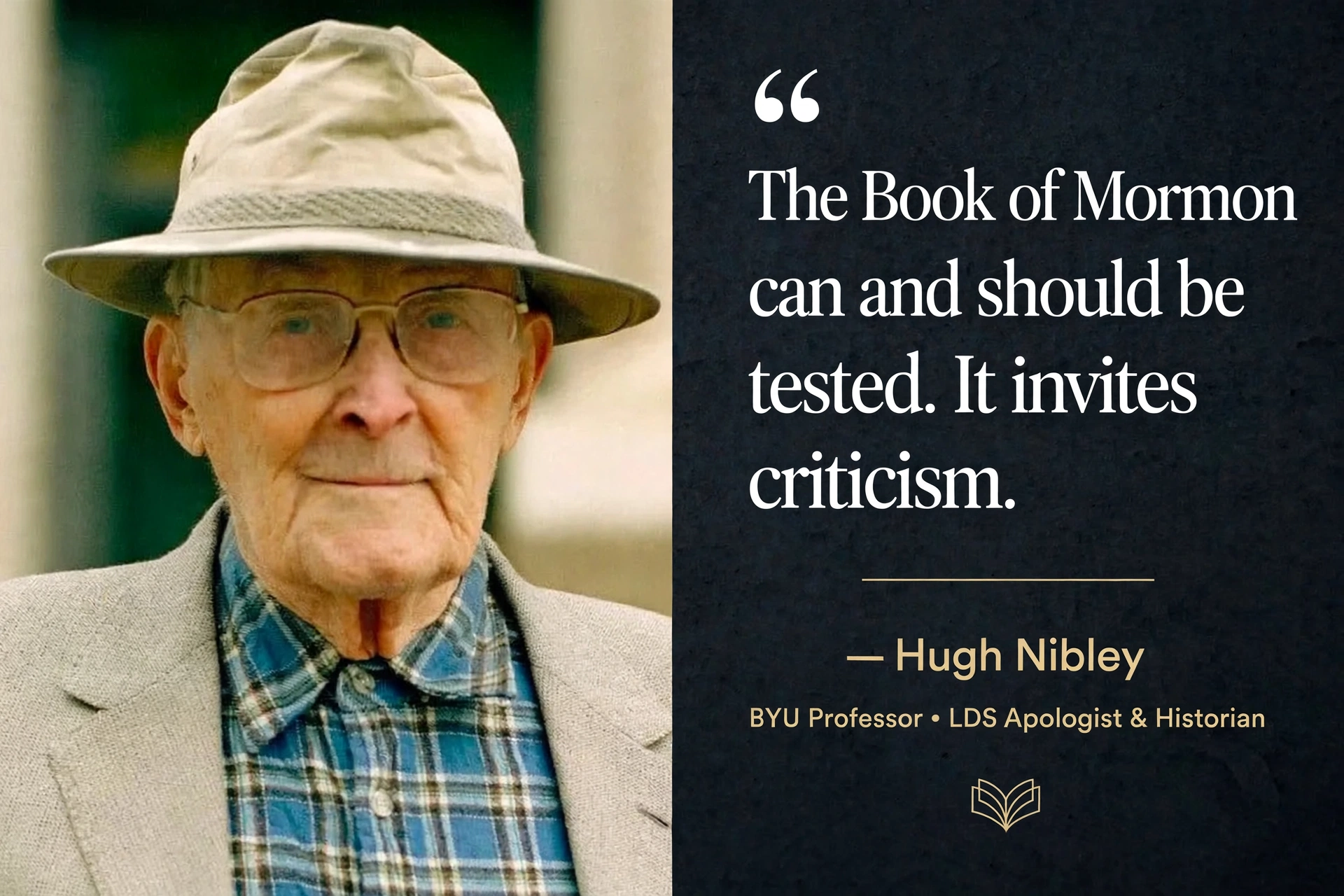 Coming back from a trip in 1966 to Central America, he said, “I learned more about the Book of Mormon from this trip… than from all the years I have been working on it, and that is because of the complete lack of definite information about anything Book of Mormon.” Contrast that with his assessment of the Hopewell:














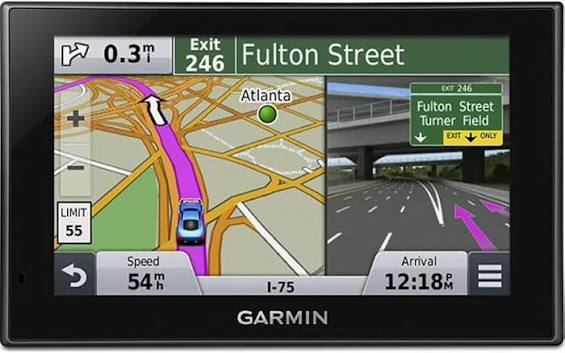 Garmin’s GPS receiver history begins with a vision in the late 1980s to bring the U.S. military’s Global Positioning System (GPS) to civilian use. In 1989, engineers Gary Burrell and Dr. Min Kao, both experienced in aviation and marine electronics, founded the company in Lenexa, Kansas, under the name ProNav. The name “Garmin” is a portmanteau of their first names. As Jon has found out, the Garmin GPS receiver has evolved into an incredibly useful tool.
 The yellow one is a ’58 Chevy that I built.
 This is a ’55 Ford pickup Rat Rod that I built. It has a lot of different parts from all kinds of cars. A 454 big block Chevy motor with an overdrive automatic trans.
 Rat Rod – 37″ HumVee rear tires, with a truck rear end.

 This is a ’33 Ford coupe that I built. It has a 350 Chevy motor that I built. It is an automatic trans. It has 18″ wide tires on the back.
 This is a ’53 Studebaker pickup, that I put on a ’93 Dodge frame. It has a 5.9 Cummins diesel, with an overdrive trans, and is a 4×4.
 This is a ’60 Rambler American that I built. It’s a Nissan 4×4 frame, with a Mercedes diesel engine and 5 speed manual transmission.
 This car I built for Carol. It is a ’41 Chevy coupe, that I put on an ’87 Chevy 4×4 pickup chassis. She calls it Chuck, for car/ truck.



 FOREWORD