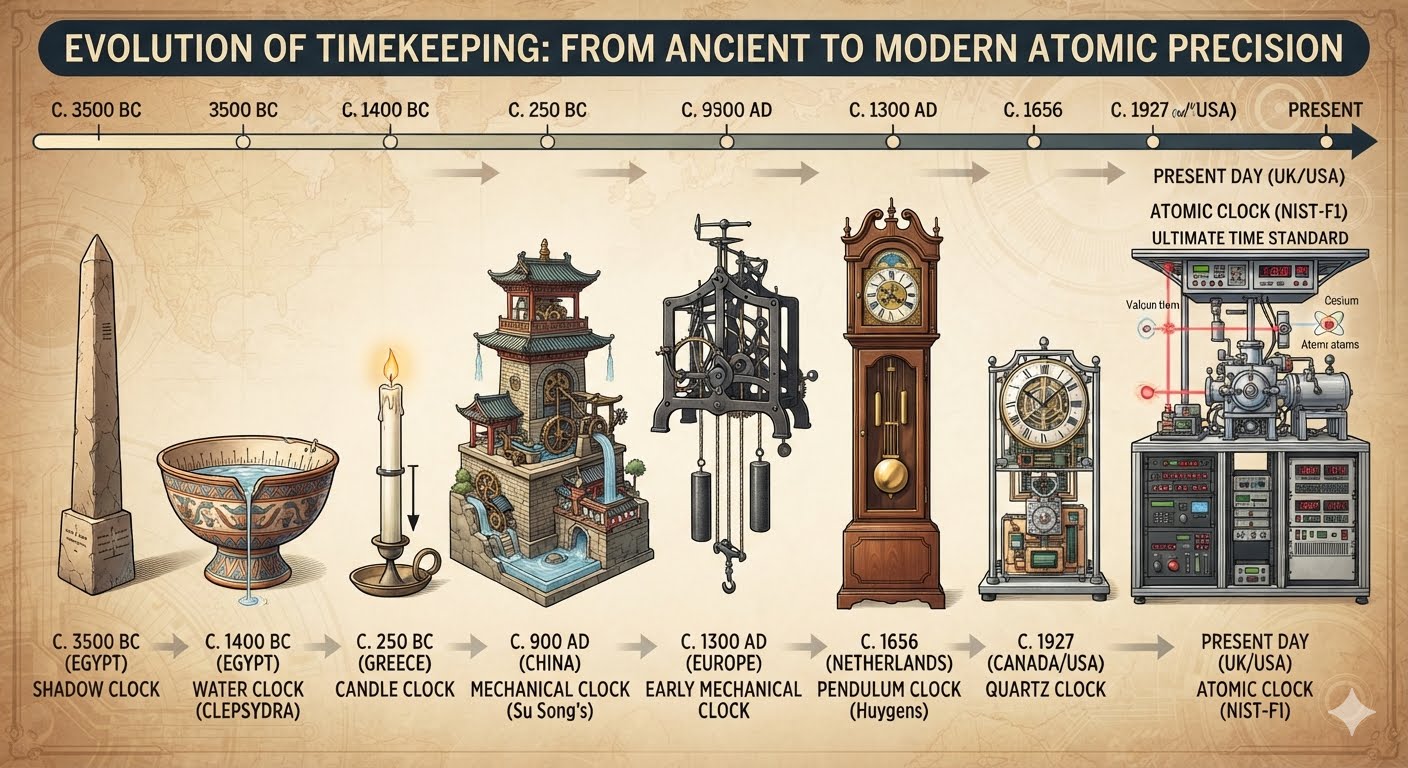
How good is a clock?
Timekeeping accuracy and stability have improved a billion fold in my life time and society has benefited enormously; look at GPS for example. Atomic clocks are the heart of GPS. I was privileged to help in the development of GPS. The invention of atomic clocks has brought about this enormous improvement.
No Clock is Right!
When I used to teach seminars in Boulder, CO, at NBS/NIST, I would tell the attendees that every clock is wrong except the one you define as right. I feel the Lord gave me the algorithm for optimally combining the readings of an ensemble of atomic clocks so that the computed output was better than the best clock in the ensemble. That AT-1 algorithm was used to generate official time for the USA. It was a software clock calibrated by the Primary cesium-beam frequency standard that we had in the laboratory in Boulder. I was the nation’s timekeeper for most of my 32 years in Boulder.
Who invented the Atomic Clock?
Isidor Isaac Rabi came up with the idea of an atomic clock back in the 1940s and was a Nobel Prize recipient as a result. The Rabi Award was named after him and he was the first recipient of the award in 1983. I was privileged to have breakfast with him the day he received the Award in Philadelphia at an international Frequency Control Symposium.
A Clock is a Two-Part Device for Keeping Time
Atomic clocks are no different than previous clocks. One can think of a clock as a two part device: an oscillator (like a pendulum) and a counter (like the clock face giving you clock’s time reading). The oscillator for an atomic clock is a photon’s frequency. The counter is the electronics adding up the number of cycles of the photons. Physicists don’t like to call microwaves photons, but the concept is the same–and electromagnetic wave.
Astronomical Time
Historically time was kept astronomically. Solar time is as one counts the cycles of the sun going over head as the earth spins. Ephemeris time is as one counts the years as the earth goes around the sun. Lunar time is as one counts the cycles of the moon orbiting the earth. The Hebrew calendar is a lunar calendar. The sidereal year is as one counts the earth’s rotation with respect to the stars. And the tropical year is as one counts the time from one vernal equinox to the next.
The equinoxes and the solstices are tied to the spin axis direction of the earth with respect to the sun. Since the spin axis direction in space is like a spinning top with a precession rate of about 26,000 years. The tropical year is 20 minutes and 24 seconds shorter than the sidereal year—the time it takes us to go around the sun.
The Evolution of Rabi’s Idea
Based on Rabi’s idea atomic clocks came into being. When atomic clocks came into being, we learned that their timekeeping ability was significantly better than any astronomical phenomena. So in 1967 the length of the “second” went from astronomical to the oscillations of the microwave photons of a particular resonance phenomena in the cesium-133 atom: “The second is the duration of 9 192 631 770 periods of the radiation corresponding to the transition between the two hyperfine levels of the ground state of the caesium-133 atom.”
How to Best Use Atomic Clocks
Once atomic clocks came into existence how to use them and how to predict accurate and precise time with them became important questions. My master’s thesis published in 1966 gave birth to what the world knows as the Allan variance (AVAR). AVAR answers these questions. As a result, I was the second recipient of the Rabi Award in 1984. ADEV is the square-root of AVAR. One can show that the timekeeping ability of a clock is ADEV x TAU, where TAU is the prediction interval. ADEV was used to make sure the atomic clocks used to make GPS work well met specification. GPS works at the nanosecond level (a billionth of a second).
GPS satellite clocks have to predict time
The GPS satellite constellation orbits the earth at about 4.2 earth radii in 12 sidereal hour periods (with respect to the stars or inertial space). The times of the atomic clocks are updated every time they cross over a tracking station. So each satellite has to predict time forward until it crosses the next tracking station where both its position and time are updated. A GPS receiver listens to at least four satellites to calculate its longitude, latitude, altitude and GPS time. From those calculations it knows its position to within a few feet and its velocity.
Time as we use it is not Time
Time as we use it is not time but time interval—the time accumulated from some origin. We are now 2026 years from 0 A.D. Your wrist watch provides the time of day. My wrist watch is always right to within about 0.2 second as it has a radio receiver tying to official time for the USA generated in Boulder, CO.
This weekend we celebrate the Summer Solstice
This weekend we celebrate the summer solstice when the spin axis of the Earth is exactly at right angles to the vector going from the earth to the sun. We have equal day and equal night. That moment is at 2024 UTC June 20th, or at 2:24 a.m. MST June 21st. I hope you are having a good sleep at that moment.
God’s TIME is most Important
As I share in my books the time we should most care about is God’s TIME. We mortals are limited by time and space; He is not and His grand purposes are roiling forward in one eternal round. His perfect plan of happiness was perfected by our Savior’s Infinite Atonement, as I share in my last and 8th book, The Infinite Atonement of Jesus the Christ, and its Significance in the Last Days. Let us use our “mortal time” to help build His kingdom that it may be here on earth as it is in Heaven (Matt. 6:10). And may we bring as many as we can to Christ. He who is the way, the truth, and the life (John 14:6), HAPPY SUMMER SOLSTICE.
PS If you want a good tutorial in layperson’s terms, Hewlett Packard asked me to write the same: THE SCINECE OF TIMEKEEPING. It has a diagram of how good various clocks are. It is available on my website: AllansTIME.COM and on the internet: http://leapsecond.com/hpan/an1289.pdf .