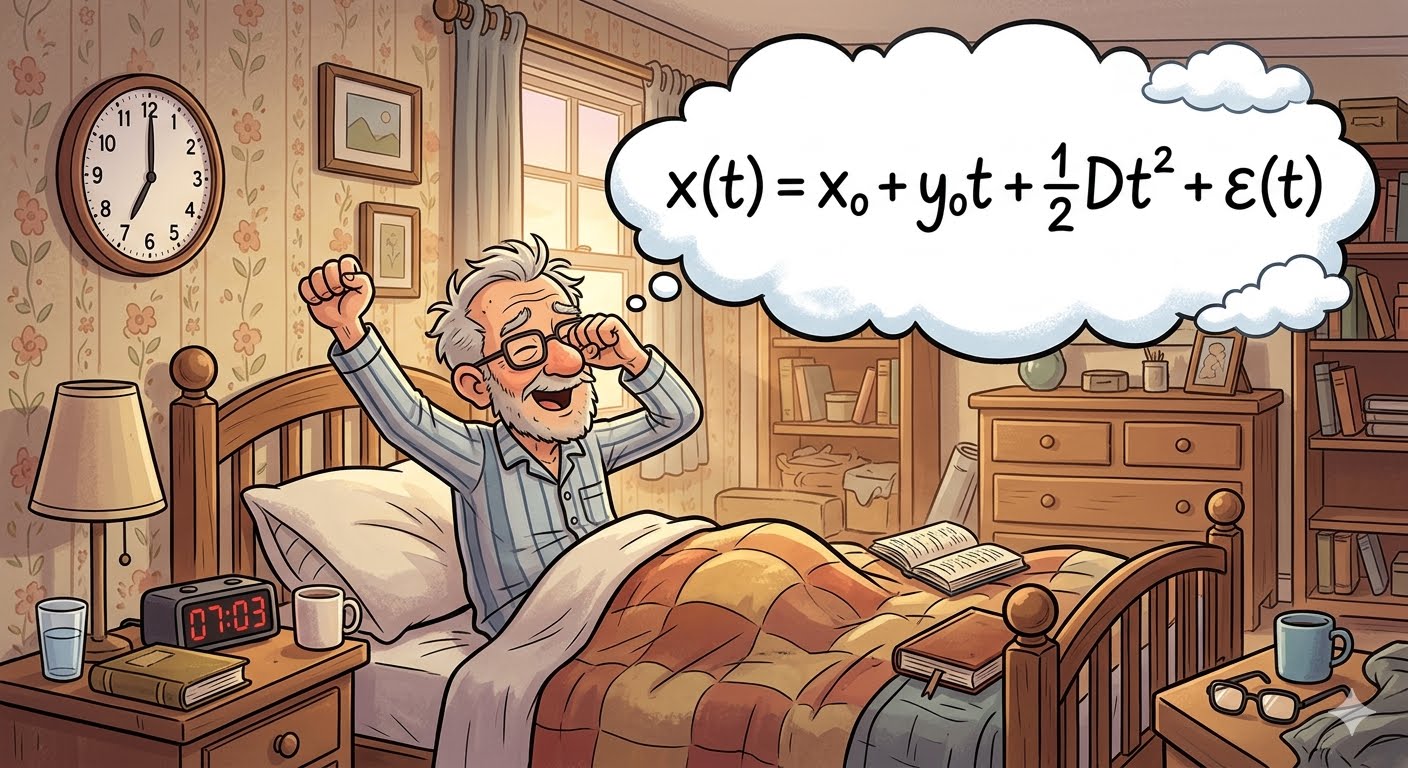
Why did I wake up this morning with this equation in my head?
Some memories have a way of resurfacing unexpectedly. This morning, I woke up thinking about an equation I taught for many years—one that represents some remarkably elegant mathematics. It may not be 250 years old, but it’s been around long enough to earn its place in the history of timekeeping.
Warning: Math ahead!
You can think of this equation in very simple terms:
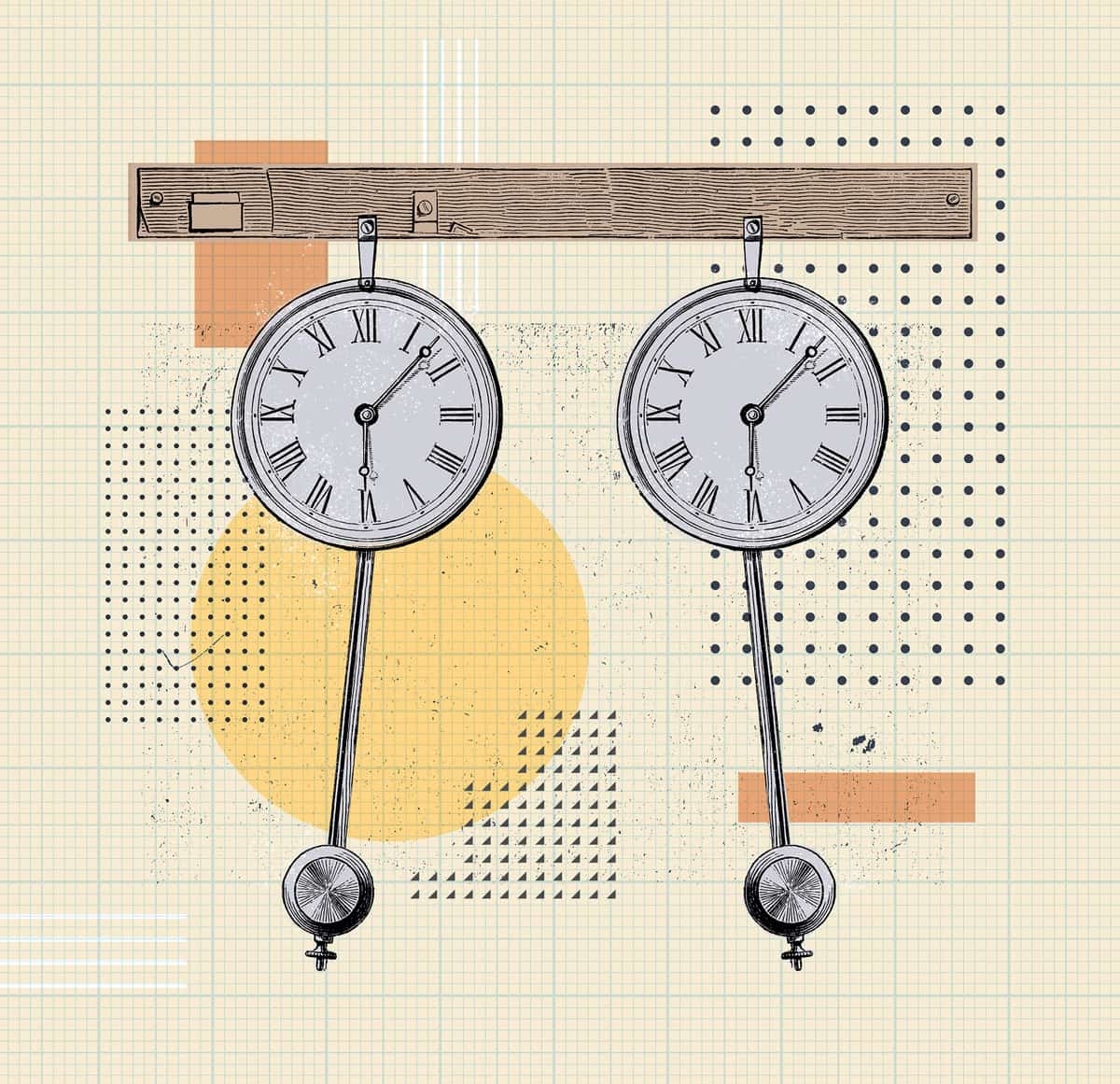
- Two clocks are synchronized if they display the same time.
- Two clocks are syntonized if they run at the same rate, or frequency–same tone. The difference in their time readings will remain constant.
- In reality, every clock experiences frequency drift, D.
As I often taught in our Time and Frequency seminars, every clock is wrong. The only clock that is “right” is the one we define to be right when generating official time—a responsibility I had for much of my 32 years at the laboratory in Boulder, Colorado. I also taught this equation to Air Force personnel as they learned to use atomic clocks in the development of GPS.
Since every clock is wrong, the question becomes: How wrong is it?
We can describe a clock’s synchronization error as x₀ and its syntonization (frequency) error as y₀. The time error of any clock can then be written as:
x(t) = x₀ + y₀t + ½Dt² + ε(t)
The final term, ε(t), represents the long-term random variations found in all clocks due to flicker-noise frequency modulation (FM). Together, these four terms account for both the systematic and random variations that determine a clock’s behavior over time.
This equation transported me back to my first days at the National Bureau of Standards (now NIST) in Boulder, Colorado, in 1960—before digital computers were available. At that time, high-quality quartz-crystal oscillators were the finest timekeeping devices in existence. This equation provided a remarkably accurate mathematical model of their performance.
Using an analog computer, we were able to model the behavior of one of these quartz-crystal oscillators, which served as part of our national timekeeping system before atomic clocks became available.
What came vividly back to me this morning was a device we designed and built to automatically remove all of the systematic terms in the equation while optimally predicting time into the future in the presence of flicker-noise FM. For a period of time, it effectively kept the nation’s time, calibrated by the primary NBS cesium-beam frequency standard and later by commercial cesium-beam atomic clocks as they became available.
I still regret that we never took a photograph of it.
I built the instrument with a Plexiglas front panel so you could watch the mechanism at work. Inside were gears that drove a phase shifter, two ball-disk integrators, and two differentials—similar in principle to the differential in an automobile—that combined signals mechanically. The two integrators continuously corrected for both the oscillator’s frequency offset and its frequency drift, allowing the analog output of to perform much like an atomic clock.
For anyone interested in the technical details, they are described in this paper from NIST:
https://tf.nist.gov/general/pdf/180.pdf .
Smart Clock Patent
In 1992 we turned this equation around and showed how every clock could be made to read the correct time. I used the data from a wrist watch as an example in the patent. My current wrist watch operates this way. Each night it listens to the standard radio broadcast from WWVB, which is synchronized with the correct time in Boulder at NIST/NBS. Then using this equation it predicts time forward to the next night’s signal reception. So my wrist watch always has the correct time to within a fraction of a second.
GPS Signal Degradation Removal
Also back in 1992 GPS had two signals, L1 and L2. L2 was free to be used by the civilian community. L1 and L2 were used by the military to get the best time and position accuracy. At that time L2 was purposely degraded to the level of about a hundred nanoseconds to prevent civilians from approaching military accuracy. I figured away to remove that degradation for precision timing purposes. Hewlett Packard hired me as a consultant and with the SMART CLOCK patent, I designed a special GPS receiver to synchronize cell towers. I was pleased that the final product worked better than my design simulations and HP sold these across the world.
THE SCIENCE OF TIMEKEEPING
I consulted for HP from 1993 until 1997. They also asked me to write an application note for their user community, “The Science of Timekeeping.” I asked Professor Neil Ashby, who we had contracted with to do the relativity needed for the GPS atomic clocks, to help, along with Cliff Hodge from the NPL in England and a space clock expert. The 88-page application note came together well and has a lot of interesting information not generally known.
For example Figure 12 is a chart of the timekeeping errors of everything from egg-timers to atomic clocks and including official time, UTC. It includes the instabilities of the spin rate of the earth as well as the time error associated with measuring how long it takes for the earth to go around the sun. The application note became quite popular and is available on my website: www.AllansTIME.com and on line as well: an1289.pdf.
GPS ADVANCED COMMON VIEW RECEIVER
While consulting for HP I asked Dr. Robin Giffard if he would help me design and build a GPS Advanced Common-view receiver with the goal of removing all the systematic errors and being just left with the measurement noise. Robin did a super job and we had one receiver at HP Palo Alto, CA, and the other at USNO in Washington D. C. to gather data and test them. The results are shared in Figure 14 of the application note. We achieved our goal of effectively removing the systematics and ended up with a time-error measurement noise of 6 nanoseconds improving as tau^(-1/2). Such that for an averaging time of a month we were able to compare frequency standards to seventeen significant digits.
These receivers were 50 times better than the GPS Common-view receivers we built in 1981 in the lab at NIST in Boulder, CO. These GPS Advance Common-view receivers have never been replicated. Robin died while jogging of an aneurism, and my wife and I had saved enough money to go on a mission for our church to West Africa, Cote d’ Ivoire. The basic idea is still out there.
THE LAND OF THE FREE
Happy 4th of July USA! May freedom continue to ring throughout our great nation, and may the gospel liberty we enjoy here be magnified during our next millennial epoch. God bless America! We are so grateful for those who gave us our inspired Declaration of Independence, US Constitution and Bill of Rights and for the restoration of the fullness of the gospel to be shared with the world to bring as many as will to Christ. His inspiration in my career path has been my main stay. THANK YOU, LORD.
David W. Allan